Author: jdvaroli

New York Artscape: Weekend Wrap-up

Umberto Boccioni (1882-1916): “Forme uniche della continuità nello spazio” (Unique Forms of Continuity in Space)

Here’s my wrap-up of several art events in New York City that I attended this past weekend: the International Art Festival in Tribeca; Yayoi Kusama’s exhibition at the launch of Mucciaccia Gallery in Chelsea; and finally, the Impressionist and Modern Art Evening Sale at Christie’s in Midtown.

Last Thursday evening (Nov. 7), I went to the opening of the International Art Festival, whichran the entire weekend in Tribeca. This young fair is organized by the indefatigable New York dynamo and impresario, Margo Grant.

“The International Art Festival is an opportunity to exhibit works by talented artists, both established and not established, who aren’t represented by local galleries,” said Ms Grant. “New York City is home to an estimated 56,000 professional artists, giving the city the largest population of artists worldwide; but only a small percentage have the chance to exhibit.”

Paintings by two artists grabbed my attention and are worthy of special mention. Take for example, Sasha Levin’s acrylic on canvas — “Day One: Let There Be Light.” (30×48 inches, 2019). 

Mr. Levin says that “the works of the great impressionist masters inspire me the most. I’m a visual person and I enjoy the challenge of painting the images that I have in my head. I also see my paintings as a running experiment of how close I can get to the best balance of shapes and colors.”

Mr Levin has been painting all his life, but his long career as a business executive consumed most of his time. Now he has the chance to focus on what he has always loved doing most — painting.
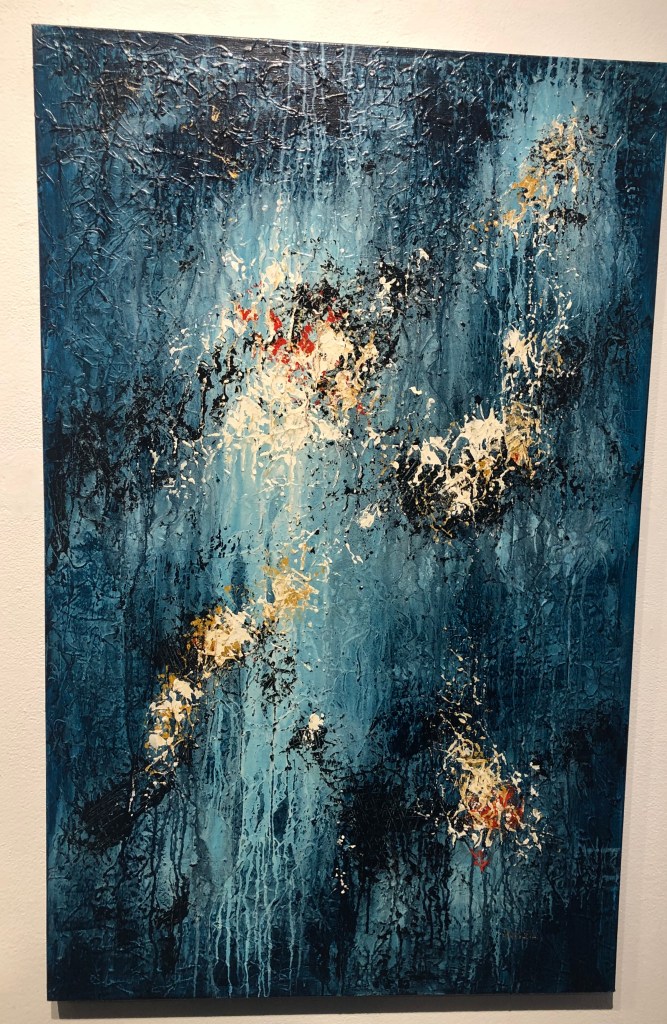
Sasha Levin, “Day One: Let There Be Light.” (30×48 inches, 2019)

My eye was easily captured by two sensual oil on canvas works by Ukrainian-born Marina Krutko. Her “Gradient” (40×40 inches, 2018) express her feelings about her new life under the southern Florida sun. Ms Krutko mixes classical portraiture techniques with a modern sexualised vision of women.

“Living in my ‘paradise’ I want to show a woman’s body and what I feel through colors in an abstract manner. My color palette symbolizes the versatility of the human soul and the changeability of one’s mood,” said Ms Krutko.

Marina Krutko, “Gradient” (40×40 inches, 2018)

Mucciaccia Gallery and Yayoi Kusama

On Friday night (Nov 8) I was invited to the launch of Mucciaccia Gallery in Chelsea, which featured a retrospective of artworks by Japanese legend, Yayoi Kusama. Mucciaccia already has galleries in Rome, Singapore and London.

On display are Kusama’s signature Infinity polka dot paintings, as well as her iconic sculpture pieces from the series “Hi, Konnichiwa (Hello)!” The artist once said: “In the universe there is the sun, the moon, the earth, and hundreds of millions of stars,” and she describes her life as one dot among thousands of others.

The selection of 28 paintings, sculptures and works on paper date from 1951 to 2008, and will be on display until Jan. 30, 2020.

Yayoi Kusama “Hi, Konnichiwa (Hello)!”

Christie’s auction of Impressionist and Modern Masters

Finally, on Monday (Nov 11) I attended the Impressionist and Modern Art Evening Sale at Christie’s where 52 of the 58 lots were sold, (a 90% success rate), earning a total of $191.9 million. Nearly 25% of that amount was accounted for by the sale of artworks from the James and Marilynn Alsdorf collection; it achieved a sale total of $42.6 million.

Mr Alsdorf was a Chicago business executive and philanthropist who died in 1990. His wife passed away this past August, which is why the collection, one of the finest in private hands in the midwestern capital, came to market just now. The heirs decided to sell the collection for reasons that are not known.

For more information about that Alsdorf collection, go to this link: 

https://www.christies.com/features/The-Collection-of-James-and-Marilynn-Alsdorf-10107-3.aspx

The top lot selling was a large painting by Belgian Surrealist artist René Magritte (1898-1967), “Le seize septembre”. The presale estimate was $7-10 million, but it sold for $19.57 million in a protracted 3-minute battle between bidders in the room and on the phones. (All final prices here include the seller’s commission).

The second most expensive art work, and the top surprise of the night, was a sculpture by Italian futurist Umberto Boccioni (1882-1916): “Forme uniche della continuità nello spazio” (Unique Forms of Continuity in Space). While the plaster cast of this statue was made just two years before the artist’s death, this statue at Christie’s was in fact cast in bronze only in 1972. (See photo at top of page).

With a presale estimate of $3.8-4.5 million, the Boccioni sold for $16.16 million in another 3-minute bidding battle, setting a world auction price for Boccioni.

Why would anyone pay so much for a Boccioni? I don’t know his art well, but Max Carter, head of Impressionist and Modern Art at Christie’s New York, had this to say: 

“Boccioni’s brainwave was to break down blocks of movement and convert them into curves that extended past the shape of a human body, before reassembling them as a forward-marching figure. As the artist himself stated, Unique Forms of Continuity in Space  was a ‘synthetic continuity’ of motion; an abstract image of man striding boldly and continuously towards a brave new world, in every direction at once.”

Other important Christie’s highlights: four Picassos finished in the evening’s top 10, led by the delightful 1949 painting, “Femme dans un fauteuil (Françoise)”, which had a presale estimate of $12-18 million, but that sold for $13.32 million

Another big surprise was Camille Pissarro’s 1892 masterpiece, “Jardin et poulailler chez Octave Mirbeau, Les Damps,” which sold for $10.26 million on a presale estimate of $4-6 million.
8 great art works at IFPDA Fine Art Print Fair

I know that many of you reading this do not live here and would love to learn more about New York City’s art and culture scene beyond the headline events that are amply covered by the major media. It’s primarily for you that I write this blog, which will focus on important and interesting art happenings and institutions that major media tend to overlook or pay scant attention to.

This past weekend (Oct. 24-27, 2019) the IFPDA Fine Art Print Fair held its 28th edition at the Javits Convention Center on the west side of Midtown Manhattan. This was my first time in attendance, which happened accidentally when a woman in a Chelsea elevator gave me a pass for the VIP opening on Oct 23. I went and liked it so much that I thought: This is reason to finally start my art blog, which has been ruminating in my head for years since I left Bloomberg and The Art Newspaper, (where I wrote for 12 years as a correspondent).

Here are my 8 favorite art works at IFPDA’s 28th edition. Why “8”? No particular reason. The overall quality across the fair was exceptional, and these art works are merely my favorites. A very big thank you to photographer Natalya Nabochenko for taking such wonderful shots of the art works at the fair.

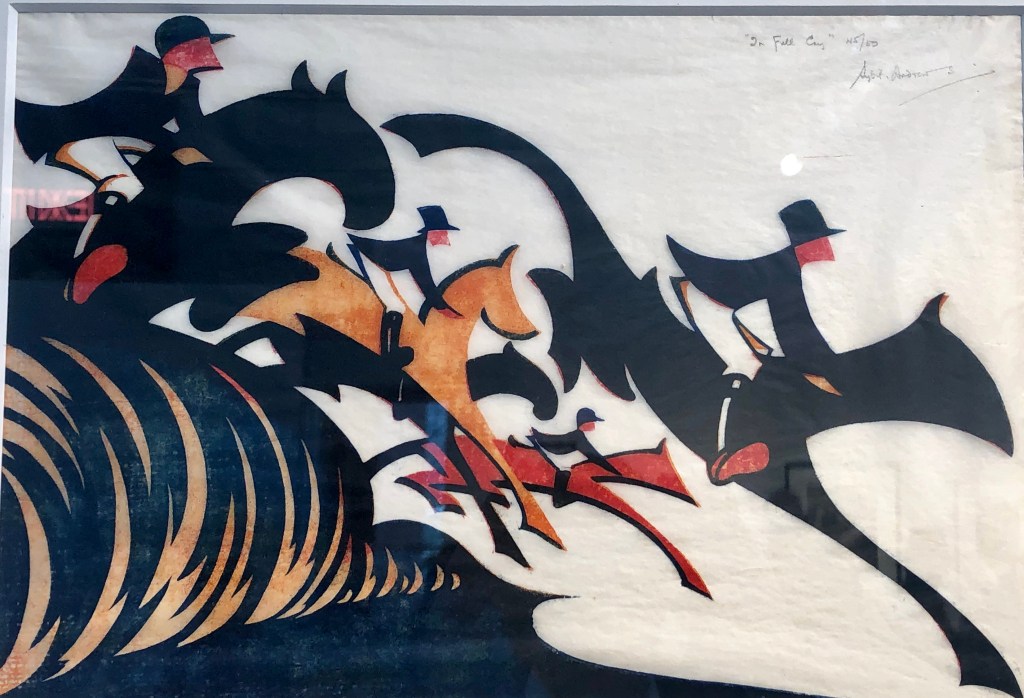
1) “In Full Cry” (1931; 29 by 42 cm) by Sybil Andrews (1898-1992) at the stand of Osborne Samuel Gallery, (London). This magnificent modernist work is hand-printed from three blocks. It’s signed and numbered from an edition of 50. Nothing can compare to Andrews’ exquisite and novel artistic vision. This work, as well as the next one, were by far my favorite pieces at this art fair. 

In Full Cry” (1934) by Sybil Andrews,
at Osborne Samuel Gallery (London)

2) “Speedway” (1934; 32 by 23 cm) also by Sybil Andrews was at the stand of Redfern Gallery (London). This extraordinary depiction of motorcyclists so vividly and skillfully conveys the power of their motion speeding down the track. Andrews made this work, as well as “In Full Cry,” during the decade when she cooperated closely with her mentor, Cyril Power. 

Speedway” (1934) by Sybil Andrews,
at Redfern Gallery (London
)

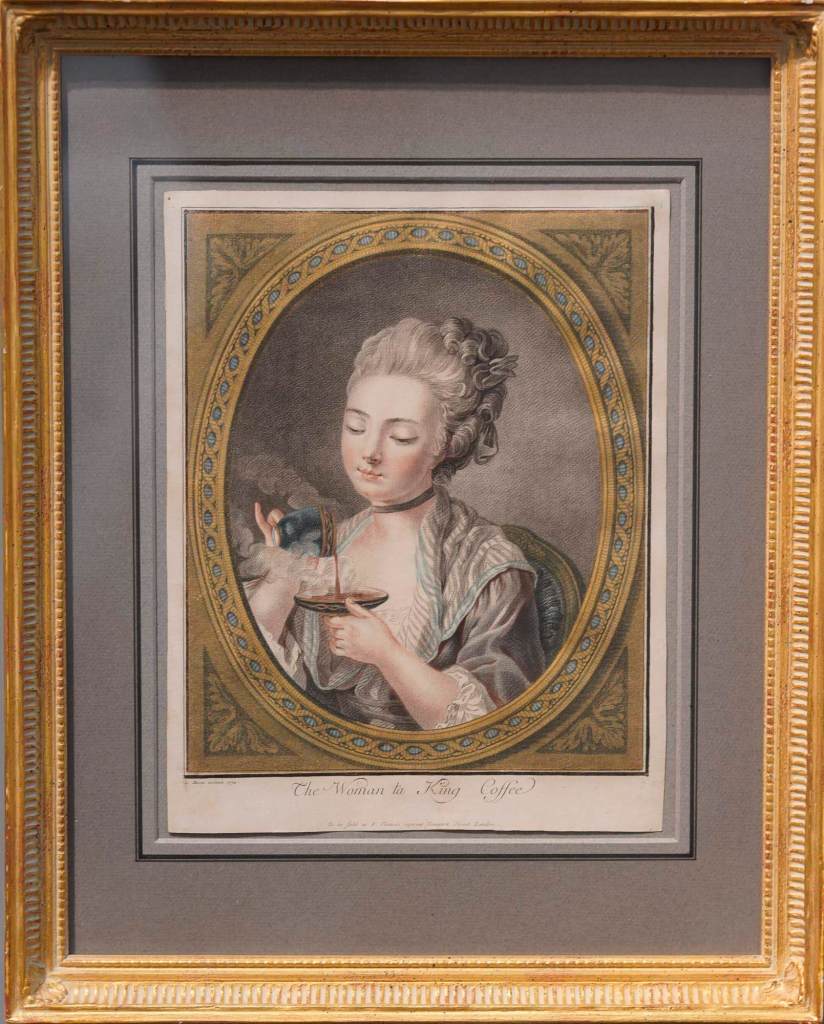
3) I couldn’t be indifferent to “Woman ta King Coffee” (1774; 28 by 23 cm) by Louis-Marin Bonnet (1736-1793), which was displayed by R.S. Johnson Fine Art (Chicago). Why the strange name? “This gold application on the print was an illegal procedure in France,” said a gallery official. “The artist tried to create the impression that it had been made in London, but his English wasn’t so good, and therefore, the mistake in the title.” Yes, it should have read: “Woman Taking Coffee”.

Woman ta King Coffee” (1774) by Louis-Marin Bonnet
at R.S. Johnson Fine Art (Chicago)

4) Isselbacher Gallery (New York) had a large poster by legendary Czech artist, Alphonse Mucha (1860-1939). Created in Paris in 1898, where it would have been displayed on city streets as an advertisement, this work is titled “Job” – the name of French cigarette rolling paper. While very famous and successful during his lifetime, Mucha faded into oblivion after his death because post-war leftist Europe found him too bourgeois. He’s enjoyed a revival since Czechia’s Velvet Revolution in 1989, but still, he remains an outsider for the international art world, and one rarely sees his works at major art fairs and auction houses.

Job” (1898) by Alphonse Mucha at Isselbacher Gallery (New York)

5) “Jewelled City” (1931) by Gerald Geerlings (1897-1998) at Catherine Burns Fine Art (California) depicts the magical effect of the Chicago skyline in the 1930s. This work had an original print run of 32, and is signed by the artist. “This is a special impression in blue ink and it’s his most famous work; usually, he used brown ink,” said a gallery representative. “This is Michigan Ave at night in Chicago. The Magnificent Mile.”

Jewelled City” (1931) by Gerald Geerlings
at Catherine Burns Fine Art (Berkeley, California
)

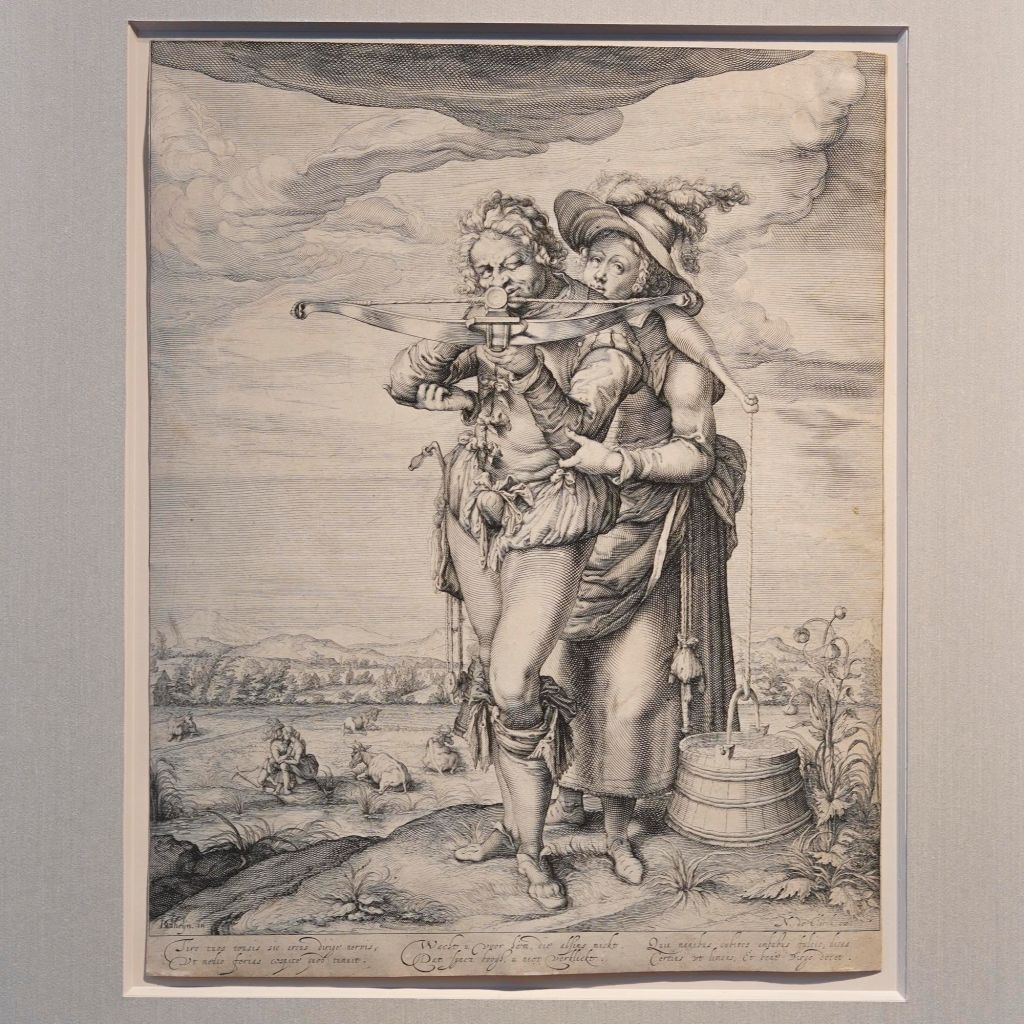
6) David Tunick Gallery (New York) had a wonderful work by Jacob de Gheyn II (1565-1629; 40 by 32 cm). You can’t easily walk past “The Archer and the Milkmaid” because he’s pointing his crossbow right at you. Experts say this work is charged with erotic meaning, and the archer is akin to Cupid. The milkmaid on his right wears his hat, indicating a rather intimate relationship. Indeed, in 16th century Europe milkmaids had a certain ‘easy reputation’.

“The Archer and the Milkmaid” (circa 1610)
by Jacob de Gheyn II
at David Tunick Gallery (New York)

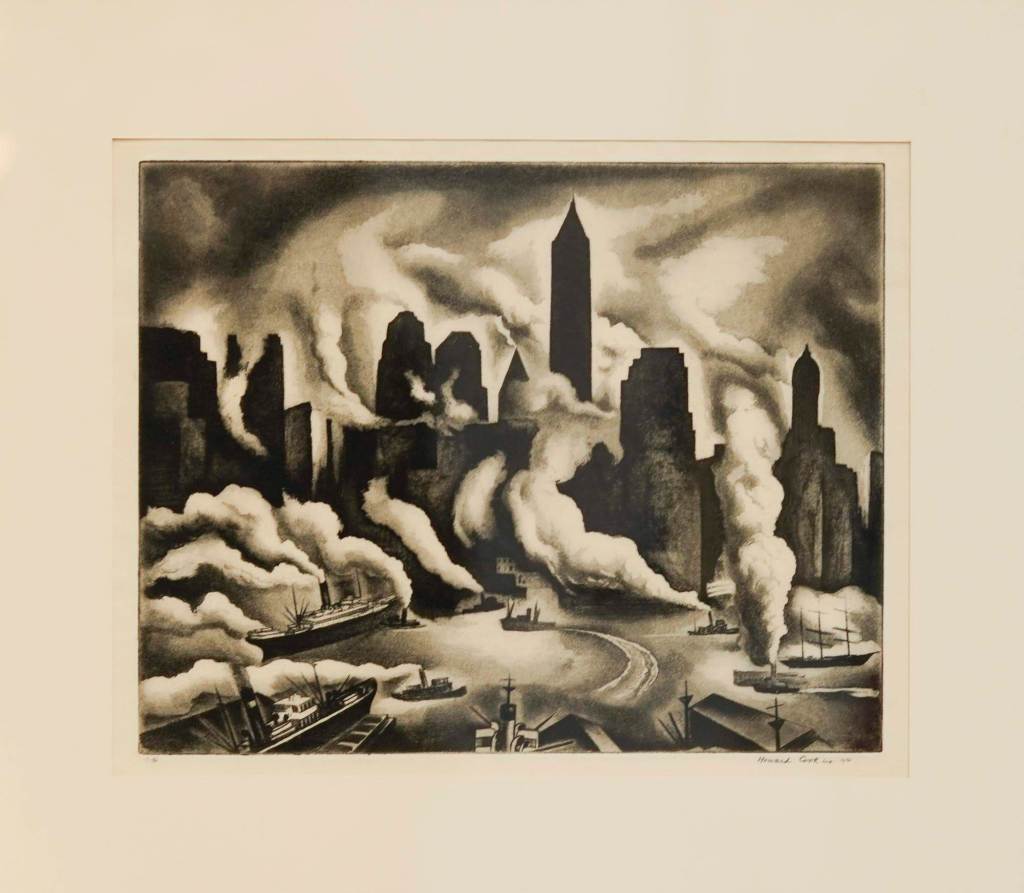
7) “Harbor Skyline” (1930) by Howard Cook (1901-1980) at Catherine Burns Fine Art is a bleak but poignant work of urban poetry — an extraordinary silhouette of Manhattan as the Roaring 20s came to a close, and the Great Depression began.

“Harbor Skyline” (1930) by Howard Cook
at Catherine Burns Fine Art (Berkeley, California
)

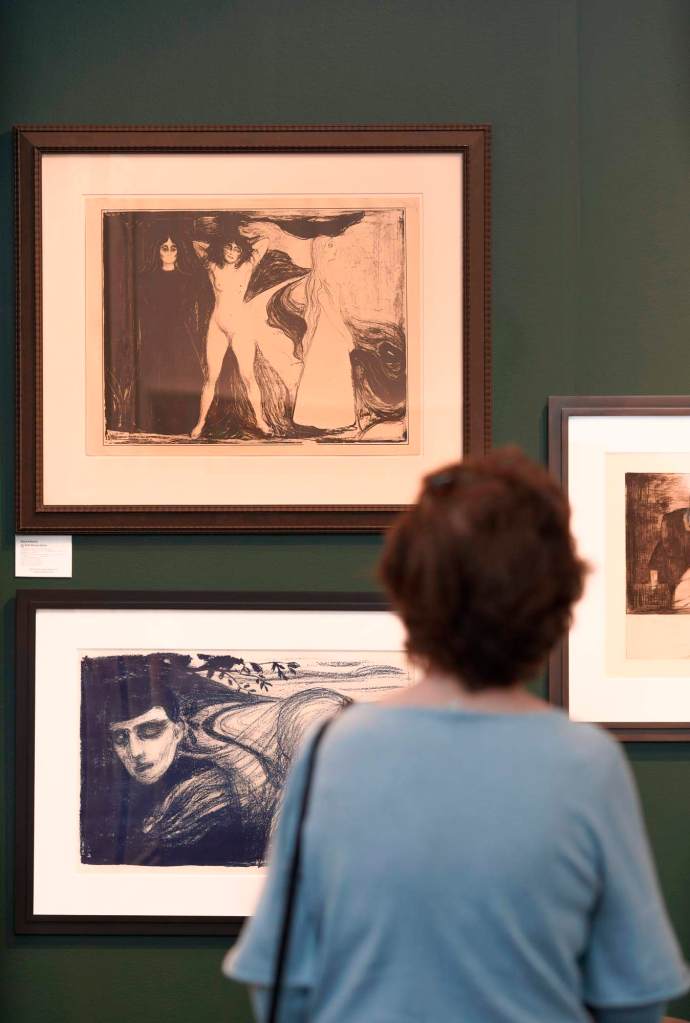
8) Finally, two existential works from Norway’s Edvard Munch (1863-1944): “Separation II” (1896) and “Woman/Sphinx (1899), both at John Szoke Gallery (New York). The artist, who is most famous for “The Scream”, was obsessed with the deep issues of life and existence, especially eager to depict anxiety and separation. 

Edvard Munch’s “Woman/Sphinx” (1899) and “Separation II” (1896)
at John Szoke Gallery (New York)

Introduce Yourself (Example Post)

This is an example post, originally published as part of Blogging University. Enroll in one of our ten programs, and start your blog right.

You’re going to publish a post today. Don’t worry about how your blog looks. Don’t worry if you haven’t given it a name yet, or you’re feeling overwhelmed. Just click the “New Post” button, and tell us why you’re here.

Why do this?

  • Because it gives new readers context. What are you about? Why should they read your blog?
  • Because it will help you focus you own ideas about your blog and what you’d like to do with it.

The post can be short or long, a personal intro to your life or a bloggy mission statement, a manifesto for the future or a simple outline of your the types of things you hope to publish.

To help you get started, here are a few questions:

  • Why are you blogging publicly, rather than keeping a personal journal?
  • What topics do you think you’ll write about?
  • Who would you love to connect with via your blog?
  • If you blog successfully throughout the next year, what would you hope to have accomplished?

You’re not locked into any of this; one of the wonderful things about blogs is how they constantly evolve as we learn, grow, and interact with one another — but it’s good to know where and why you started, and articulating your goals may just give you a few other post ideas.

Can’t think how to get started? Just write the first thing that pops into your head. Anne Lamott, author of a book on writing we love, says that you need to give yourself permission to write a “crappy first draft”. Anne makes a great point — just start writing, and worry about editing it later.

When you’re ready to publish, give your post three to five tags that describe your blog’s focus — writing, photography, fiction, parenting, food, cars, movies, sports, whatever. These tags will help others who care about your topics find you in the Reader. Make sure one of the tags is “zerotohero,” so other new bloggers can find you, too.