Female energy is something special and magical. A woman’s energy and success in life are inextricably linked together. Art is probably the highest form of expression for a woman — it’s a combination of her capacity to give birth to life and to beautify our world.
Marina is inspired by the beauty, charm and uniqueness of women, each with her own world. Each woman is a universe, each a mystery. Female power and beauty is a very deep and fascinating topic for Marina, and through her art she is able to unravel and decipher the feminine mystique.⠀
“I’ve been drawing for as long as I can remember. Creating paintings is inspiration. This is oxygen for me, my wonderful mood and constant development,” said Marina.
Life’s intricacies and vicissitudes led Marina to a fruitful period of work as an interior designer. Her knowledge of colors, their influence on one’s mood, atmosphere and health have proved useful. Her early oil paintings were painted inspired by her favorite French artists: Van Gogh, Rousseau, and Monet.
She graduated from a specialized art school under the watchful eye of experienced and capable teachers. The careful instructions of her painting teacher had a powerful influence on her vision and understanding of artistic images.
Later, her artistic training continued for several years at the St. Petersburg Stieglitz Academy of Painting. Some time later, she enrolled in the Academy of Painting and Applied Arts in Savonlinna (Finland). Finally, she had the good fortune to study under the watchful eye of the genius of modern impressionism Bato Dugarzhapov.
In addition to erotic and bold female images, currently Marina’s art centers around portraits. “With one glance, you can both elevate and overthrow,” Marina believes. Her portraits are unique, highly personalized, full of immense power and charged with individual energy. But most of all, these portraits are characterized by sincerity and faithfulness to the essence of the subject.
In her portraits, Marina conveys the subject’s emotions to the viewer, their unique sense of strength, with powerful beauty and energy. Her painting hanging on your wall is an electrifying charge for success in your life; a visual movable feast.
In general, all of Marina’s paintings are vibrant, filled with volume, color, and content. She masterfully combines textures, relief elements and traditional acrylic and oil painting. Her masterful use of various techniques creates the effect of a 3D image that allows the paintings to appear in multiple ways depending on different lighting conditions.
Her paintings seem to come to life and are imbued with a force of motion.
“What kind of home interior is there without painting; these works of art are the cherry on the cake in interior design,” says Marina.
And Marina’s paintings make for the ultimate gem to crown one’s interior.
For more information about Marina, please visit her official page on Saatchi Art, Art Majeur and Instagram:
The entire world has faced tremendous upheaval in the past four years. I think I speak for nearly everyone when I say that we are all quite exhausted at having the ‘honor’ to live in this ‘exciting’ and highly chaotic turning point in history. I’ve literally heard many adult friends say how they wish that they could travel back in time, to the era of their childhood when they had no worries and cares.
I recently reconnected with an artist who has brilliantly captured this zeitgeist that’s so prevalent across the globe today. I first met Yuri Ulyashev literally on the eve of our tumultuous era of – in early March 2020, just four days before New York declared a state of emergency and locked down. Then, during the pandemic we lost contact.
During these years of pandemic and now war, all of us have undergone tremendous changes personally, psychologically and professionally. For me, it’s quite exciting to see the changes experienced by Yuri, who in the past four years has dramatically grown and matured as an artist, simultaneously expanding his artistic vision and depth, as well as discovering new creative horizons and insights.
“I’m looking for a new direction in art that’s based on the Russian cultural code of the 19th and early 20th century, and to reinterpret this for the modern audience, giving it new meaning and significance,” said Yuri in an interview.
Yuri Ulyashev
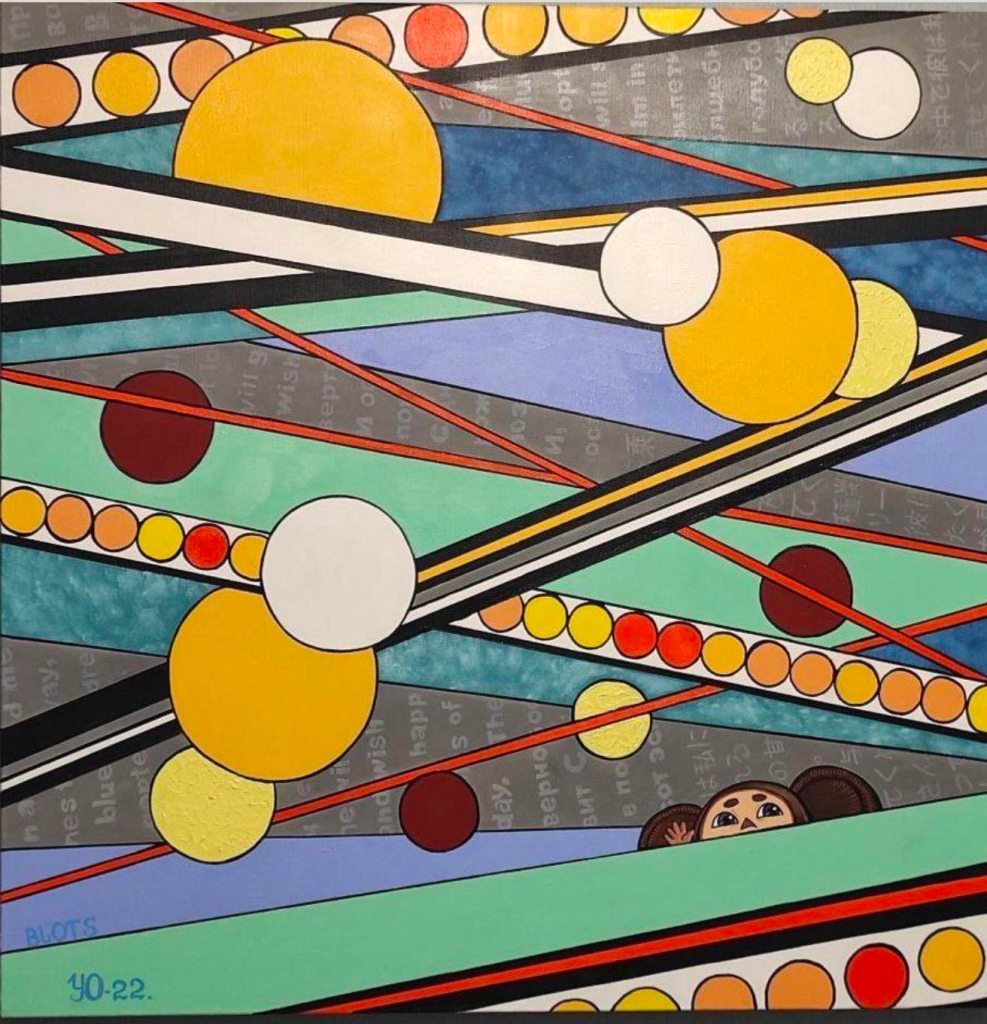
His latest art project, “Rodom iz detstvo”, which roughly translates into English as “Originating in Childhood”, is Yuri’s new set of 10 abstract art works that will make their world debut in his hometown of Moscow on March 14, 2025.
“Abstraction in the outline of childhood” is how Yuri personally describes his new series of works. “Despite all the circumstances that each of us encounters as adults, the system of values and our world view are formed in childhood.”
“We are most sincere when we are under 13 years old – as a child we interact with the world sincerely,” Yuri adds. “My art seeks to return us to that time when we were children – open, sincere and honest. The series is based on a departure from academic canons and traditions to experiments with familiar images of pop culture in a new unusual format, where characters from world-famous cartoons suddenly and wittily appear among simple geometric shapes.”
Named by his parents in honor of Yuri Gagarin, the first man in space, Mr Ulyashev also seeks to be a trailblazer in his own right – he believes that an artist is a person who looks at reality from a different angle, and he does so within the framework of a transformative vision to convey to people important ideas that surround us in everyday life. Through his artistic vision and use of color, he is able to skillfully elicit the philosophical essence of an object, as well as give it new meaning and significance.
The “Rodom iz detstvo” series is heavily influenced by the Suprematism of Malevich and the Avant-gardist Kandinsky. Yuri appreciates how the great abstract painter distinguishes something important from a series of ordinary things, and is able to demonstrate the energy that he puts into his works by using a combination of colors.
Yet, he’s also inspired by the Russian icon and how it found a new interpretation in the art of Malevich, whose “Black Square” (1915) was a protest against established fine art. “Black Square”, which Malevich originally placed in the red corner in place of an Orthodox icon, figures prominently in Yuri’s art.
Of the ten works in the “Rodom iz detstvo” series, here are four that particularly struck me both visually and philosophically.
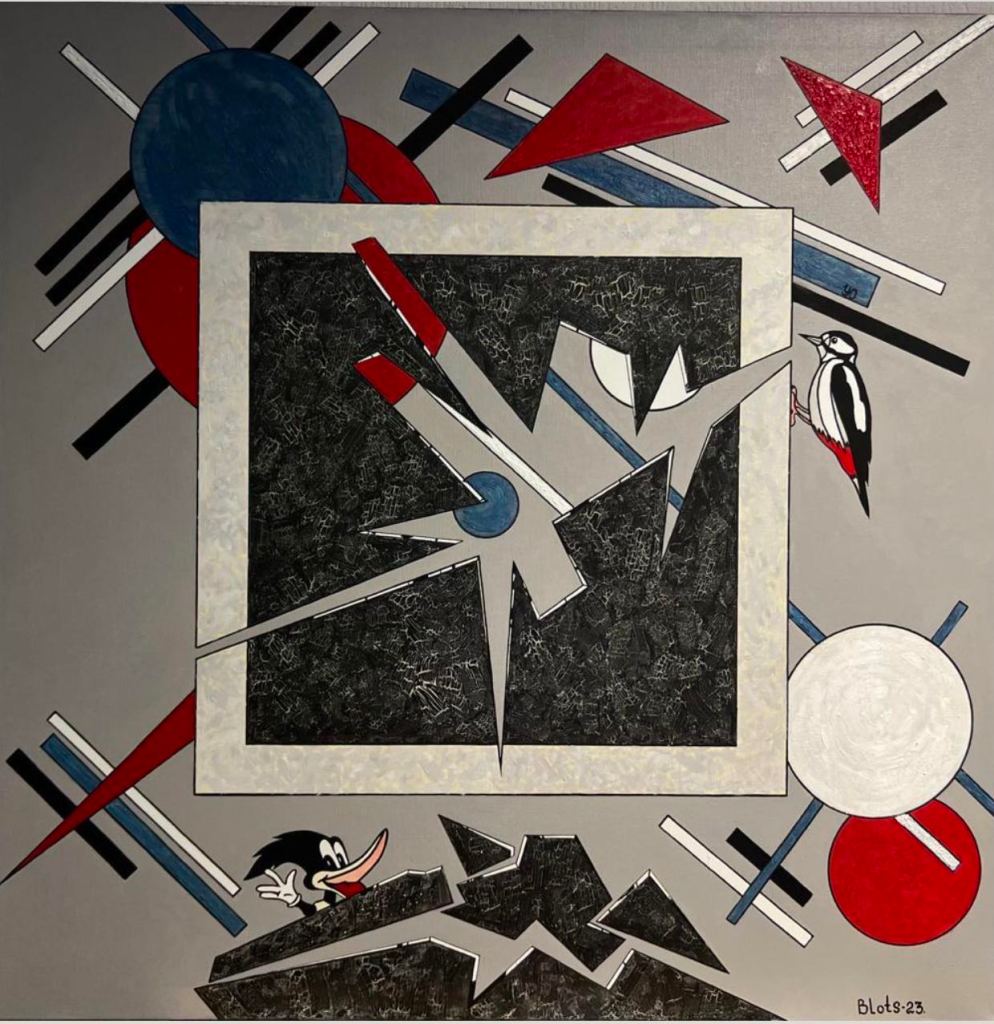
“Discovering a New Self”
“Discovering a New Self” (2023); 1 m x 1 m, Oil on canvas.
In this first work in the series, Yuriy tackles the ubiquitous ‘black square’ of our digital world, which was commonplace during the Covid pandemic when everyone was on Zoom. Many people chose not to show themselves, and turned off the video function – all that was visible was the ‘black square’. In this sense, Malevich was a prophet, but Yuriy subverts Malevich’s original intention by adding in a woodpecker, a homage to the mischievous popular children’s hero.
“I mock people who turn on their ‘black square’ during a video call. I prefer that people put on the camera. We can be ourselves, even self-ironic. Put your camera on and let’s see how involved you are in the work that we are doing,” says Yuri.
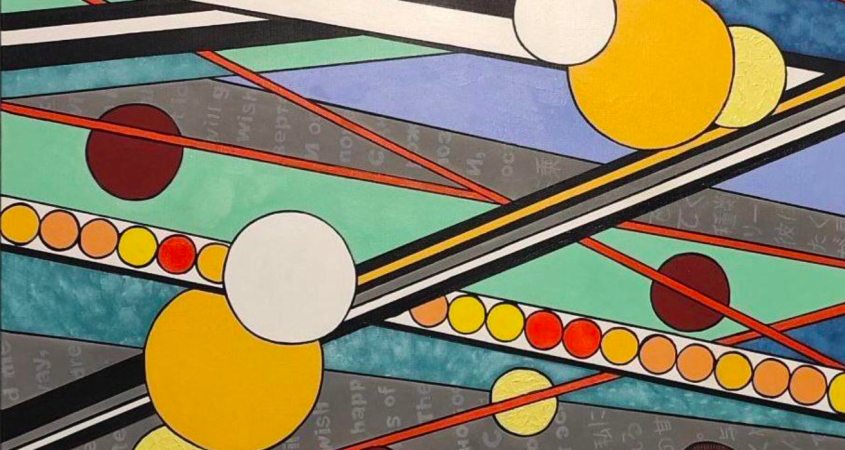
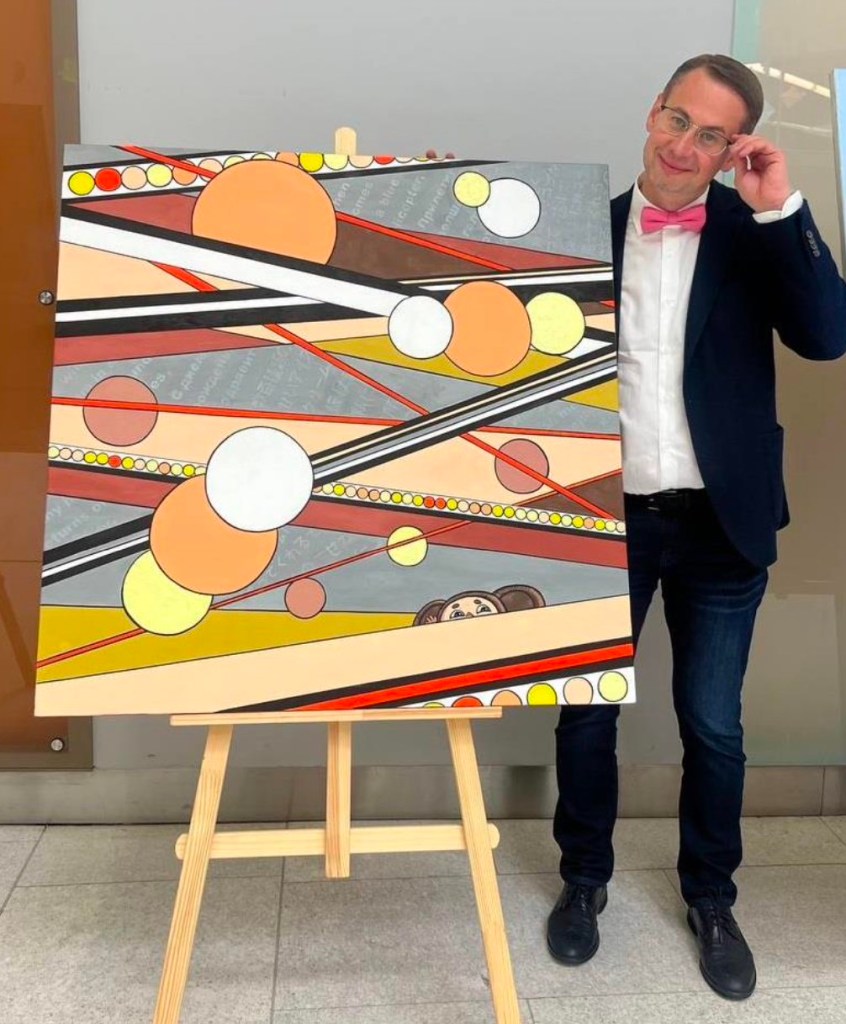
“I Will Carry the Suitcase, and You Will Carry Me”
“I Will Carry the Suitcase, and You Will Carry Me”; 1 m x 1 m, Oil on canvas.
This work is inspired by one of the most beloved Soviet cartoons – one with global success, and which evokes warmth and nostalgia. Cheburashka. A recent film with this hero shattered records. The forms of Malevich make it possible to draw any hero. This cartoon is known for the popular Russian birthday song, which in this painting is inscribed in the background – in Russian, Japanese and English.
“Web of Time”
“Web of Time”;1 m x 1 m, Oil on canvas.
Challenge, move forward, and don’t be afraid of anything. Dare to dream! This is the ethos of Spider man and this artwork. Despite the apparent complexity of the world we live in, Yuri shows us all of its abundance, transparency and possibilities. Spiderman is a symbol of the city, fighting crime, and all around percolates the forms of Malevich and Kandinsky. One, two, three Jump! Don’t be afraid.
“Fly, Dream!”
“Fly, Dream!”; 1 m x 1 m, Oil on canvas.
Superman is the world’s most popular film and cartoon character – he is a global cult figure. And here, once again, he’s in a world inspired by the Russian avant garde. He speeds fast into the future and cuts the moon, making a powerful statement that the impossible is possible! This painting has speed and drive. Influenced by Malevich and Kandinsky – all this looks modern and comprehensible.
Dresden has long been one of my favorite cities, ever since I passed through in summer 1991, on my way from Prague to Berlin. Previously, I had often traveled around Western Germany, where pretty much everything had been bombed during the War and replaced with modern cities. Likewise, I knew that Dresden had been pulverized in a similar horrifying fashion.
What I didn’t know, as the train from Prague pulled into the central station, was that large sections of Dresden’s historic center had been rebuilt after the War. The Saxon city, which for centuries had been a gem in Germany’s glorious crown of arts and culture, arose from the ashes, and today it once again stands as a thriving center of art, architecture, music, design and more.
So, I couldn’t conceal my delight, when about seven years ago, I discovered one of contemporary Dresden’s spectacular modern musical gems — Lidia Valenta. Serendipity brought us together. We ‘met’ in autumn 2014, brought together by Facebook’s algorithm because my profile page featured a photo with a view of the Konigstein Castle, which is just a short drive south of her home in Dresden
Why did I have this photo? Because I had visited the castle and the Elbe River region earlier that year, just a few months before Lidia’s existence became known to me. That trip was so delightful, highly memorable and I loved that view from the Konigstein Castle. And so, I decided to attach the photo (below) to my Facebook profile. Good thing I did!
View from Konigstein Castle, Saxony, Germany
What great fortune and immense pleasure to meet Lidia. I quickly became enamored with her extraordinary voice, and have closely followed her career over the past seven years. In fact, we finally got the chance to meet in person in early winter 2015, when I returned to Saxony.
Lidia is an extraordinarily versatile singer, known for her poetic Russian album “Oblaka“, as well as for her album of songs, “Weihnachten“, which is popular in Germany for jazz interpretations of the traditional German Christmas carols.
Lidia works with many different international singers, musicians and poets. She performs at major music venues in various countries, writes songs and draws inspiration from Russian, German, British, and American poetry. She is always on the move, eager to explore art forms, innovate musically, pursue project after project with vigorous enthusiasm and originality.
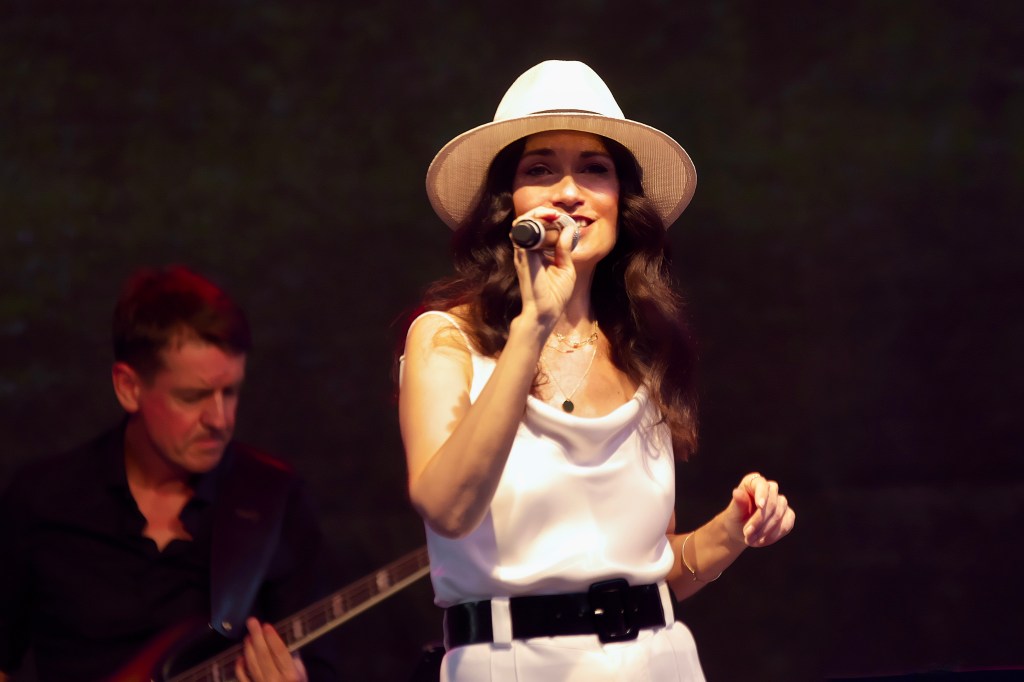
Lidia in concert
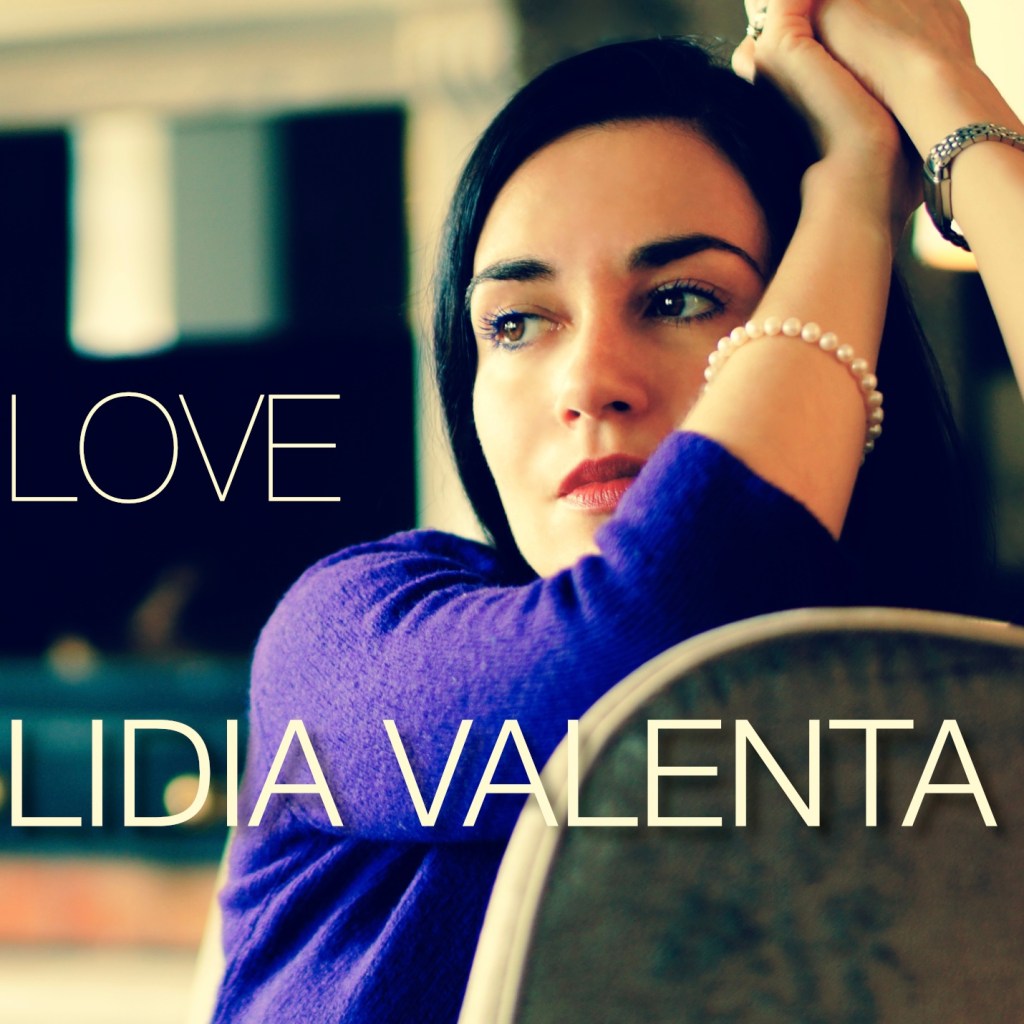
Now, this month, she has a new music album, “Love“, which has surprised me again. I’m one of the few lucky ones to have the chance to hear these new songs. Her voice’s high recognition, with its warm, intimate and yet crystal clear timbre reaches a scale that ranges from soft tones to energetic passion. Her voice definitely evokes authentic feelings which are so integral when listening to any sound or song.
I can certainly say that this excellent combination of 13 different and professionally composed songs is a tremendous success. The light melodic jazz that she conjures up with her seductive voice, along with a refined art-pop beat, are complemented with sensitive ballads. The musical arrangements and the band’s score perfectly close the circle of this sophisticated new album. This album was done with Love, and that’s why you want to listen to it over and over again.
In short, there are few jazz singers like Lidia Valenta, and her artistic career is as an ever-evolving and beautiful mosaic. I commend her on this new album and look forward to many more in the years to come.
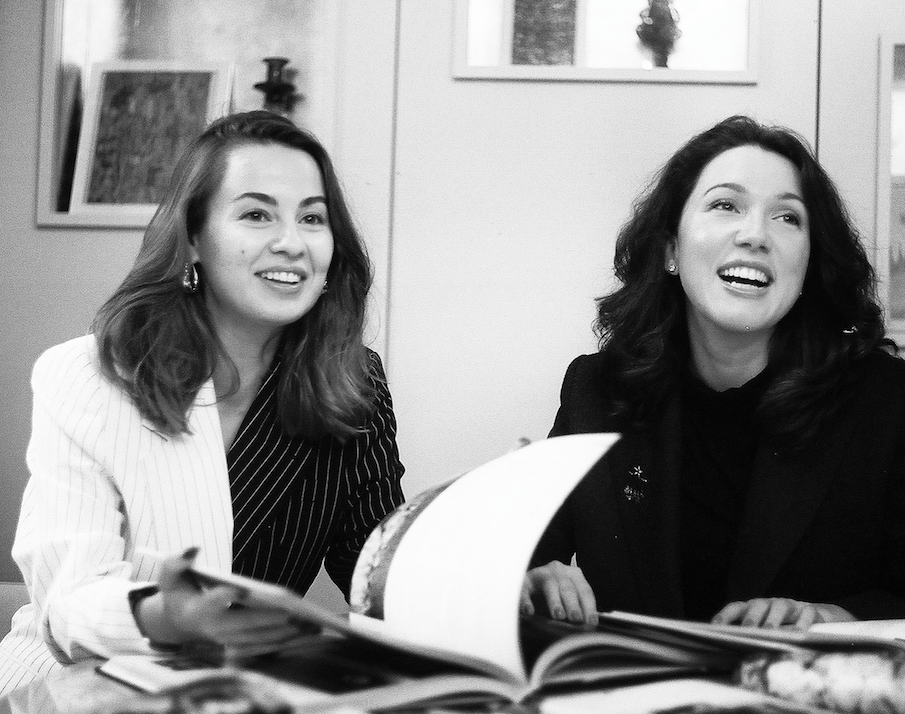
Anastasia Petrovskaia and Maria Korolevskaya, founders of The Art Partners, an art collection management office based in London and operating internationally, share their thoughts on the art world during the pandemic: on the struggles, opportunities and the future of the industry.
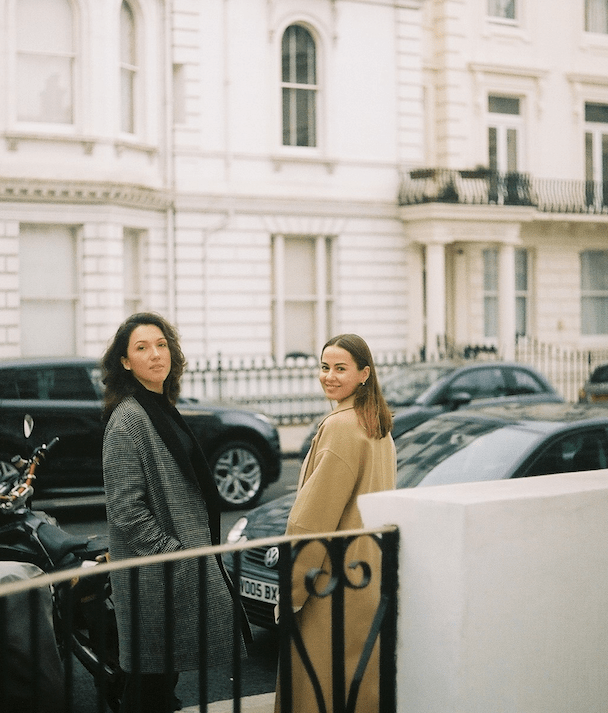
Maria Korolevskaya (left), and Anastasia Petrovskaia (right) during curatorial of The Photo London Magazine (Photo credit: Erik Dias)
How did you start The Art Partners?
When we launched The Art Partners five years ago our goal was to go beyond the ordinary art consulting business model and focus on the Family Art Office concept where clients receive tailored approach and exceptional collection management support. We understood the importance of an exclusive and niche enterprise to look after clients, not only during the purchasing process but for years to follow. It’s about creating conversation and building a community of passionate people. We organize private visits to artist studios, exhibitions, art fairs and museums.
How are art galleries in LA, NY and London dealing with shutdowns and other restrictions? Have many closed or will they soon close? While the answer seems to be overwhelmingly negative, is there any silver lining?
Yes, it’s been a difficult year for art galleries, and since March 2020 many shut for months. Even as restriction eased, galleries still can’t recover since social distancing measures allow a few clients inside a gallery. In the first half of 2020 gallery sales dropped 36% on average, according to UBS&Art Basel. Galleries rely on human interaction, and a major part of income comes from art fairs. As a result, the segment is hit the hardest, especially smaller galleries with turnover under $500,000 a year. Many galleries have laid off employees but thankfully only a small percentage of galleries have decided to shut down completely.
On a more positive note, galleries have made up for lost in-person and art fair sales by embracing online formats. Galleries use their websites, Online Viewing Rooms and third-party aggregators to sell art, as well as uniting efforts. For example David Zwirner introduced Platform, dedicated each month to a different city and offering other galleries to showcase artists. The current trend toward the digitalisation of gallery sales will continue in 2021 and beyond.
What about art fairs….?
By the end of the year, almost all art fairs switched to the Online Viewing Rooms model and adjusted user experience to meet client needs during the pandemic. Our favorite was Art Basel and Untitled, and recently Fiac had a great user experience. But, we still must see how the changes will impact art fairs: Which will survive?; Will there be fewer?; Will they be smaller in size? We hope the art calendar won’t be cancelled in 2021, but Art Basel HK already shifted its date to May, and September for Basel.
What about collectors? Is the current market situation favorable to collectors? There has been a drop in the number of paintings sold at auctions compared to the previous year, according to published data.However, auction houses just released their end of year reports, and there are signs that give us reason for hope. Sotheby’s and Christie’s attracted new clients that account for 36% and 40% of total sales, respectively; these new clients were largely millennials. Sotheby’s private sales also increased by 57% (almost £1 billion) and Christie’s by 50%. Hence, the shift was of course for collectors to keep buying, though buying online. Without being able to visit auction houses in person, collectors were ‘forced’ to purchase artworks online. Therefore, collectors who were able to adapt to the new normal haven’t experienced any significant difficulties, auction houses have made it fairly easy to buy and sell artworks online. On the downside, this move towards digitalisation has negatively impacted the primary market and emerging artists. As collectors were more confident in buying artists they were already familiar with.
Anastasia Petrovskaia (left), and Maria Korolevskaya (right) in London (Photo credit: Erik Dias)
You mentioned that in 2020 auction houses saw an increase in new buyers, especially younger ones. There’s a stereotype that art investments are only for the mega-rich, so how can you explain this phenomenon during a global financial crisis caused by COVID? How wealthy does one have to be to start collecting art?
We advise clients to begin by investing comfortable amounts and increasing with time, if their financial situation allows. When you begin to collect art the key is not only your money but your time. Regarding why the number of collectors increased over the last year, one of the reasons is active digitalisation of the art world due to the pandemic, which has democratised the market, making prices transparent and more accessible too (so one can see that apart from very expensive pieces there are thousands of much more affordable works on offer). This has freed many from prejudice, as well as making collecting much less intimidating – to buy something online rather than going into the gallery. This is especially the case for younger generation. The market is no longer as exclusive as it once has been, it is no longer restricted to high-net-worth collectors who have good relationships with dealers, auctioneers and gallerists. We’ve also noticed that recently more new young collectors became our clients. Also, there are lots of interest in NFTs and digital art mainly from business and tech background individuals, not necessarily a traditional type of collector who goes to the art fairs and biennials.
If the art market is more transparent and entry barriers are dropping, should an emerging art collector work with an art consultancy firm or any ‘middle man’? Will you be adjusting the way your company works?
Our company helps with exactly that. We bring certainty to the client. Our expertise, knowledge of the art history and connections allow us to select and find the best works based on client’s taste and current trends. Furthermore, we understand that the majority of emerging collectors will be unable to dedicate the right amount of time to learn more about art and explore the global art scene. So we’re not afraid to become irrelevant in the future. Moreover, we’re gladly the bridge that unites new technology with the right audience. There are many interesting startups working with blockchain and AI in the art field and plenty of collectors haven’t heard about them. To be able to make a transition to a technology-run world we still need human recourses to do that.
What do you think about artists? How are they coping professionally and psychologically with COVID and not being able to live and work as before?
This past year has mostly affected artists personal projects and exhibitions, which were cancelled or postponed. Museums have struggle a lot, but it’s a different topic. Speaking about artists’ work, they could continue as before and perhaps, more effectively with less pressure from intense art fair calendars and overexposure. Besides, they are supporting one another through great initiatives, such as the Artists Support Pledge. Of course it has been more vulnerable for emerging artists as they are only on the stage of earning their recognition, although social media channels and popularization of online sales were quite helpful.
What are your plans for the future?
Our digital collection management platform, the Art Vault, is nearly complete. It is going to be our first tech product, which will allow our clients to keep all of the information on their collection online and easily manage it. In the future, we will aim to expand our business and move further outside the art world. We want to spread the message and to influence a synergy of art with the fields of science and technology; together with reaching wider audiences, developing our artist residencies, improving our work with clients and engaging in new exciting collaborations.
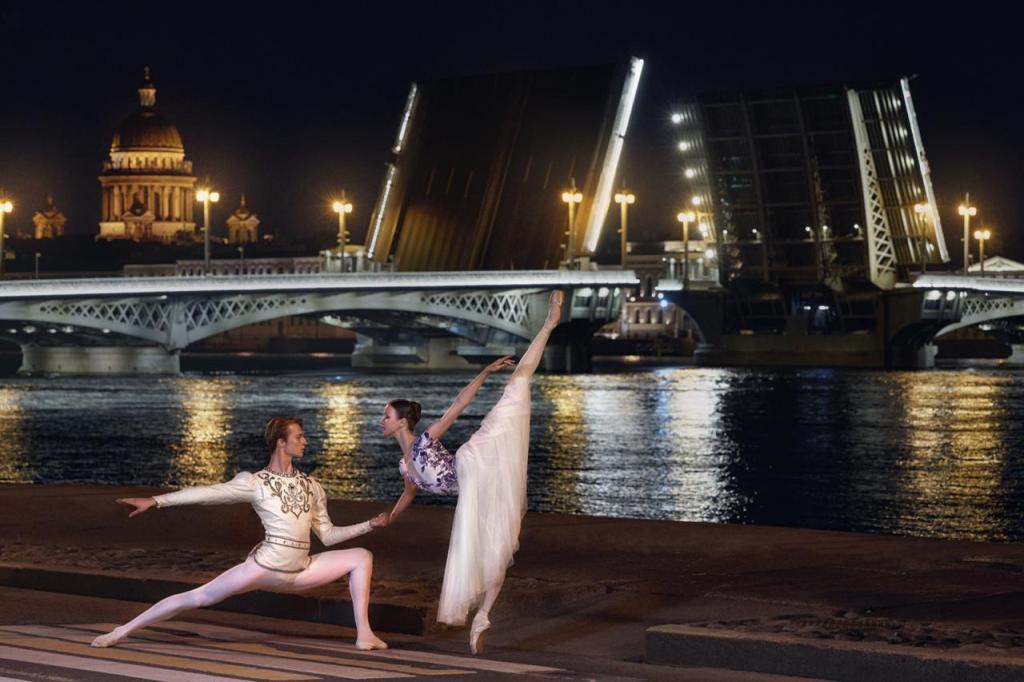
Russian ballet STARS — Vsevolod Maievsky and maria iliushkina. Photo by Natalie Bero
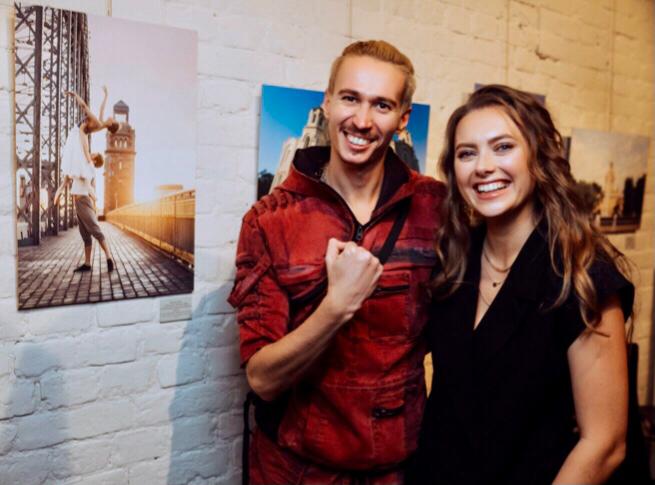
New York Artscape was created to focus on small but ground-breaking art events in our city, and over the past several years we waited with great eagerness for the completion and premier of “Classical Petersburg”, an original collection of 40 photographs of the legendary St. Petersburg ballet set against the backdrop of the historical city’s architectural gems.
The brilliant author, Natalie Bero, has for almost five years been resident in New York and was hoping to hold the world premier here. The pandemic, however, changed those plans, and the premier took place in her native St. Petersburg on Nov. 11 at Molbert Gallery.
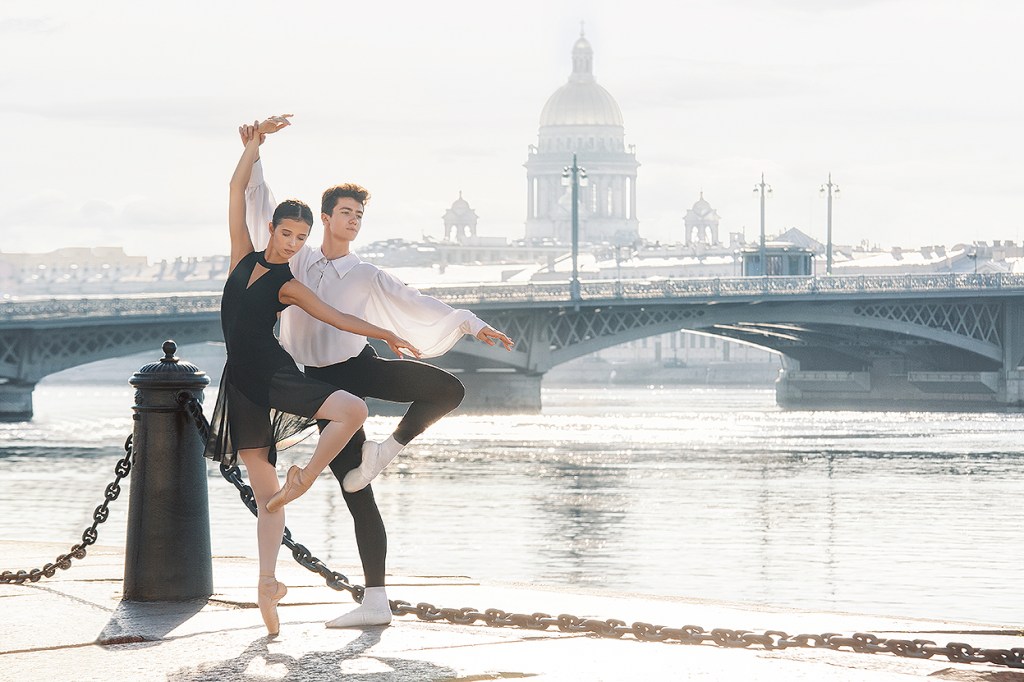
Stars of THE Russian ballet — MARIA KHOREVA and petr attikov. Photo by Natalie Bero
Despite this loss, it’d be a pity not to write about this magnificent exhibition, even though it couldn’t premier in the Big Apple. In addition, Natalie’s exhibition is a historic event. For the first time ever, a photographer has skillfully caught each flawless moment when famous Russian ballet dancers achieve perfection in harmony with the surrounding historic city.
The exhibition shows the harmonious connection between the St. Petersburg ballet and the city’s architecture. Silhouettes of buildings, urbanized landscape, as well as the strict geometry of bridges and streets are intertwined with the movements and postures of top ballet dancers.
RUSSIAN BALLET STARS — MARIA ILIUSHKINA and VSEVOLOD MAIEVSKY. PHOTO BY NATALIE BERO
“Through photography, I demonstrate the language of spatial arts – ballet and architecture talk with the viewer about the mutual influence of man and the urban environment,” said Natalie in an interview. “I like to bring a little kindness and warmth to this world. I do it through beauty. It helps to distract from negativity, from sadness and grief, from problems.”
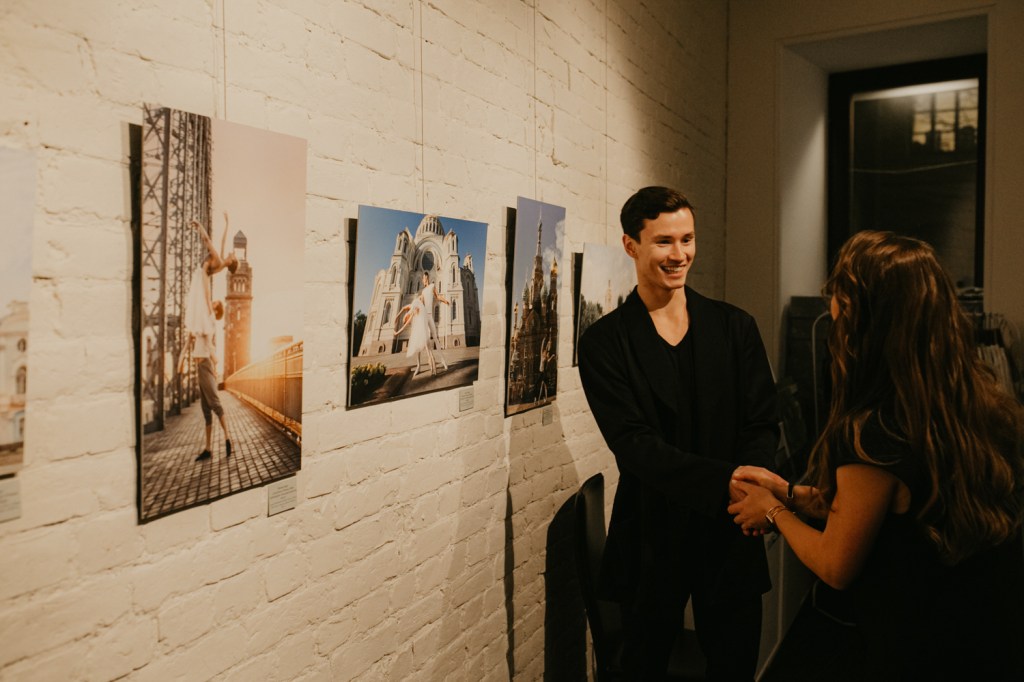
RUSSIAN BALLET STAR — MAKSIM ZENIN — AT THE OPENING ON NOV. 11
Indeed, Natalie’s photographic art is radical precisely because it’s a much needed return to all that is beautiful and noble. These photos, which combine the majesty of Russian ballet with the grandeur of St. Petersburg architecture, return the viewer to a time of classical civilization and beauty.
“Contemporary art often has ugly and negative connotations; I rebel against those notions. St. Petersburg’s ballet and architecture is universally recognized beauty,” Natalie added.
Star of the Russian ballet — IVAN grebenshchikov — and Natalie Bero at the exhibition opening
Natalie depicts St.Petersburg not just as a setting, but as a character in the ballet. She shows the dancers in impossibly perfect moments of balance that defy human physical limitations. These are the images that viewers worldwide appreciate and admire when we think of the beauty of Russian art, culture, and architecture, epitomized in the exquisite city of St. Petersburg and the perfection of its dancers.
Not surprisingly, this exhibition made a huge impression on Petersburgers, and was met with immense critical acclaim by local media and critics. Why? We already mentioned several reasons above. But there’s one more reason. Probably because locals have a chance to see the two best things that their city has to offer to the world — ballet and architecture. Not as during most of the year when the city is gloomy, cold and rainy; but rather, here they see their beloved city as positive, warm, and life-affirming.
We look forward to Natalie continuing this theme in other great cities around the world.
star of the Russian ballet, VSEVOLOD MAIEVSKY, WITH NATALIE BERO
Recent global events have had a heavy toll on the artistic community, both local and international. As the world’s leading art market, New York is a special place for artists in many countries. The chance to exhibit in the city is a dream for many, and something that an artist can subsequently wear as a badge of honor and which is a huge boost to their career.
In March, Troy Khasiev, a young and up-and-coming artist from Moscow, finally realized his dream of making his North American debut, a solo exhibition at the Museum of Russian Art in Jersey City. The event was quite unusual, however, and not what everyone had expected.
On March 21, his art works were hung in the museum, and in connection with the emergency situation, the exhibition opened without a viewing. It moved from a real format to a virtual one, where in fact more people can see it. Here is a link to a video about the exhibition: https://drive.google.com/file/d/1wqr4wKxGLzvpVZNp0HlUnVWaa_bUg3bz/view
While we don’t have that chance to see the very talented Troy and his art work in person, we at New York Artscape caught up with the artist and asked some questions about his life and art work.
At the age of 3, the toddler Troy began to make his first drawings; his first photographs came at age five. As a teenager, he started experimenting with digital imaging. Today, he studies and produces artworks in a range of mediums. Despite his young age, in 2015, at the age of 15, Troy showed a series of digital graphics in Venice, as part of an independent project during the Venice Art Biennale. He’s also had exhibitions in Paris and Moscow.
“While growing up I realized that I need to spend more time studying new techniques and other innovations,” said Troy in an exclusive interview. “Anyone can take pictures but an artist needs to work hard and think in order to bring something new to a public that’s overwhelmed by images, both photographic and video.”
Photography as a profession is not going anywhere. So, what’s an artist to do in order to photograph something in a unique manner, and to do it in a new way so that people will notice and appreciate you.
“Some complex digital technologies created by artists several years ago can be easily reproduced today with an app,” says Troy. “But it’s one thing to use the app, and the other is to come up with something yourself. Not everyone is capable of this.”
Troy’s art stresses a freedom of expression with innovative materials and techniques. He challenges our imaginations to invent new notions of what art is, with attention to the many-faceted notion of relationships between body, matter, time and space.
“An artist creates something new and does it consciously – The artist develops his own language,” says Troy. “I have a desire to show people how interesting and unusual something can be that they pass by without noticing.”
Through his art, Troy exemplifies a peculiar sense of universality that defies the specificity of his national culture and the environment in which he was born. He is clearly well along his stated goal of wanting to create a universal language, but to achieve this he will have to further engaged in this language, going far beyond accepted cultural and physical distance to preserve originality.
“A lot of art has been done in such a way that they are guaranteed to sell well…. This is not art that carries a deeper meaning,” says Troy. “I try to see the world from an unusual angle, a non-standard view – because I want people to hang out less on their phones and pay more attention to what surrounds them.”
A few days before our current viral madness and global lockdown, I was fortunate to have the chance to meet up with with a talented artist and interesting personality from Moscow, Yuri Ulyashev. His art works are in private collections in Russia and the USA. He’s been displayed at the International Art Festival in New York, the Texas Contemporary Exhibition in Houston, Margo Gallery in New York, the Russian Art Museum in New Jersey, and the Moscow Skolkovo Business School.
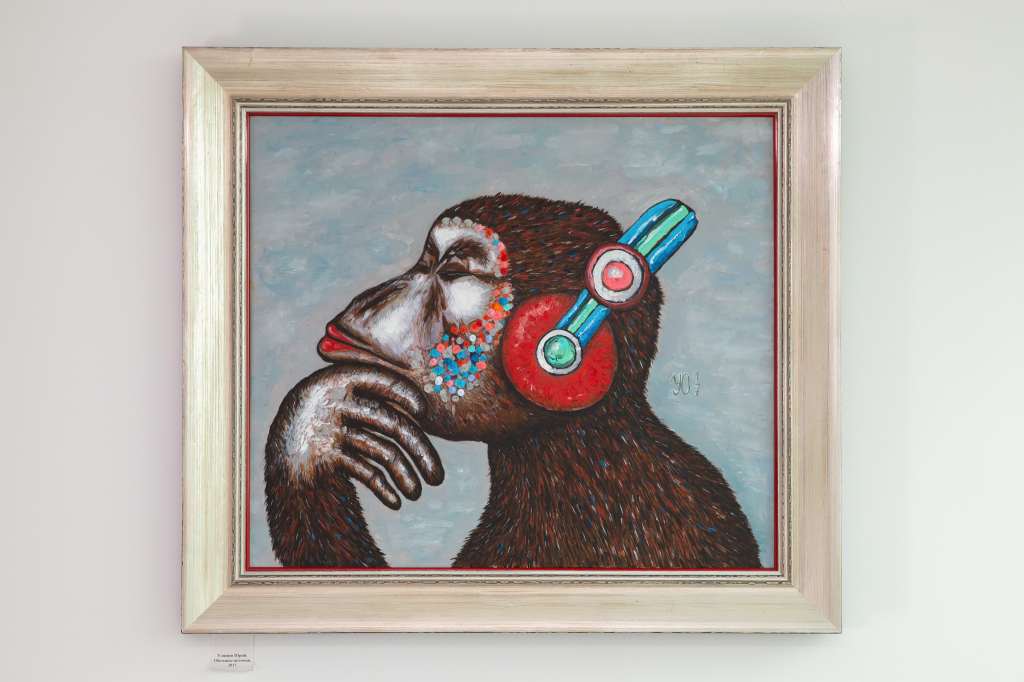
I previously only knew Yuri’s works from group exhibitions — he was last shown in Manhattan in November, at a large art festival in Chelsea. While touring that exhibition, my saturated eyes easily gravitated to Yuri’s painting, “Chimpanzee Music Lover”.
“Chimpanzee – Music Lover” (2019)
While Yuri was not at that opening night, little did I know that a few months later I’d have the chance to meet him in person when a friend let me know that Yuri was on his way to New York in early March.
Yuri is a former advertising executive but has always had a love and talent for art. I wanted to know Yuri better, so we took a nice walk around Chelsea in New York City. This was on the eve of the national emergency. His words, especially about slowing down to appreciate the world around us, are eerily prescient to the madness that we now find ourselves in.
When did you decide to become an artist?
I’m an artist at heart, so I probably made this decision at the time of my birth. This desire has long matured in my soul, and I consciously came to being an artist at the age of 38.
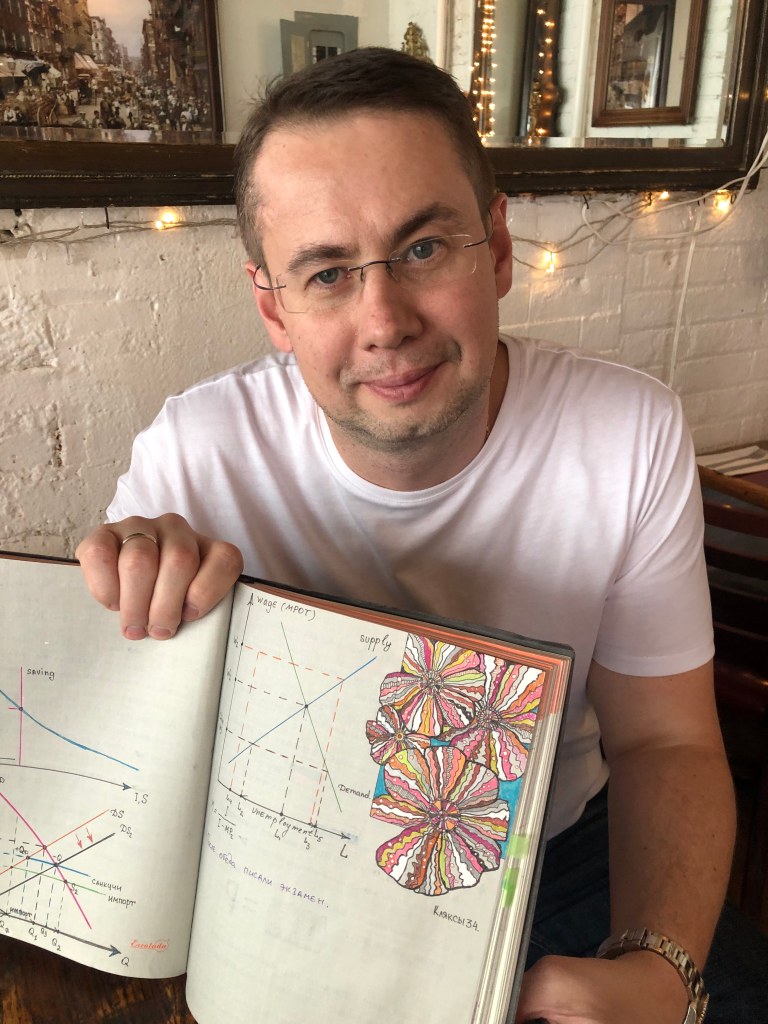
Yuri Ulyashev with notebook and sketches, in a New York City restaurant.
What inspires you as an artist?
Usually very unexpected things that rush into my surroundings: a bright color spot, a bright beautiful decoration on a woman; a beautiful dress or an interesting combination of colors on something. Inspiration comes from absolutely different places; sometimes it’s just something bright against the background of something standard and classic.
What is your philosophy?
The world of the artist is a world of something real and non-invented. Something that can stop us on our course of life and make us think. If we talk about craft or philosophy, I do not want to provoke anyone, I want to use color in relation to the thoughts and events that surround me. Every day we run around, and don’t have time to look around and see what’s beautiful. Art is a way to freeze a moment in life, and experience and appreciate the essence of life. As urban residents, we see thousands of images a day. Our senses are oversaturated. I want people to understand that it’s important to stop and enjoy a moment’s beauty.
In this age of conceptual art, why is color still important?
Through my artistic vision and my exquisite use of color, I like to bring out the essence of an object. I want to create something that people will appreciate and enjoy. There is a moment in an artist’s life when you simply want to enjoy the beauty of a moment. Take Monet who painted many different versions of the sun over the Thames. He didn’t want to make a philosophical statement. He wanted to capture a moment of beauty.
“Owl” (2019)
What is the role of the artist in society?
The artist is a person who looks at things from a different angle and he does so within the framework of his transformative vision to convey to people important ideas that surround us in everyday life.
What do you think of New York?
New York is a city of contrasts. There are luxury boutiques and then in front of the window might be a homeless man sleeping. Lots of dirt, but lots of people well-dressed. You feel like an ant amid the skyscrapers. A person doesn’t really feel a part of the city, but rather a unit in this city. New York has grown naturally and there are many buildings from older periods and you see this in the architecture.
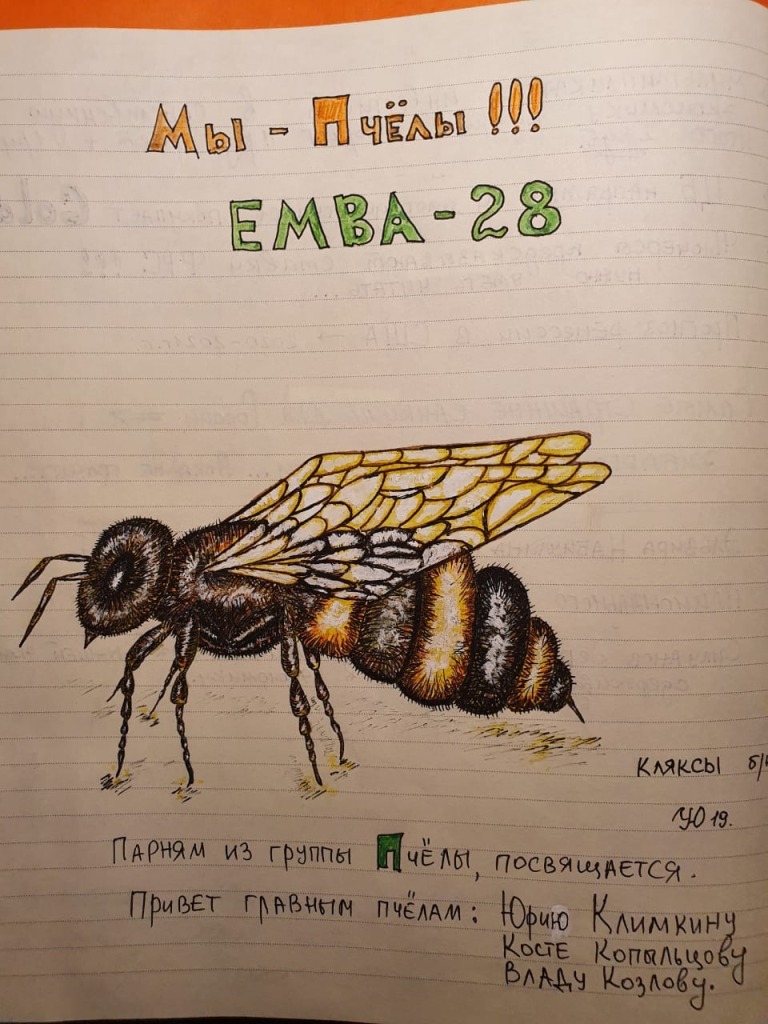
“Bee” from sketchbook
What artists do you like?
Oddly enough, my favorite artist is Vasily Kandinsky. I really love his work because he knows how to distinguish something important from a series of ordinary things. He knows how to demonstrate the energy that he puts into his works by using a combination of colors. And, of course, I really like the works of Van Gogh, Monet and Yakovlev.
My final thoughts:
Our conversation ended. Yuri and I finished our lunch at a cozy French restaurant in Chelsea. Around the block were some of the leading art galleries. We popped inside a few them. As usual, the selection on display was mixed. Some were gems; otherwise left you incredulous, wondering how and why they were even on display. Nevertheless, outside a storm was brewing and we had little idea how intense it would get. And that it would shut down the entire city and the world for 2 months. Once this is over, we all need to heed Yuri’s advice, and find the time to appreciate the beauty and finer things in life.
The Armory show, one of New York’s premier contemporary art fairs, opened today with an extraordinary assortment from across the globe. Fears of the coronavirus couldn’t keep people away, and the VIP opening was packed with thousands of art connoisseurs and creative professionals. The social scene’s buzz was almost as dazzling as the art works on display.
With 183 galleries from 32 countries, Armory brings together the leading players on the global contemporary art scene. Entrance, however, is pricey — $55 for general admission.
Below is a sampling of art works that struck my fancy for various reasons. As you know, art is highly subjective, so I will refrain from saying that these are “the best” works at the fair. They simply touched me and I can relate to them, not to mention that they are also clever and visually appealing.
Curro Gallery from Guadalajara, Mexico, has a solo exhibition by Alejandro Almanza Pereda, and it stopped me dead in my tracks. The artworks in his series, “Horror vacui” (fear of empty space), are so incongruent and jarring that many others instinctively gravitated towards it. We all were captivated by the bizarre juxtaposition of classical art and brutal modern concrete. Pereda’s art ponders the interdependence between art and architecture, as well as the violent relation between modern humans and the environment, and our tendency to want to build structures seemingly everywhere.
Alejandro Pereda’s “Horror vacui” (2020). Photo credit: NY Artscape
Moving on, San Francisco-based Christine Wang has a biting satirical work that must have ruffled many liberal feathers at the fair. “Feminist” (2020) is an unflattering critique of modern-day feminism, an ideology that has gone far beyond its noble roots and is now heavily weaponized in the North American political realm.
Christine Wang’s “Feminist” (2020). Photo credit: NY Artscape
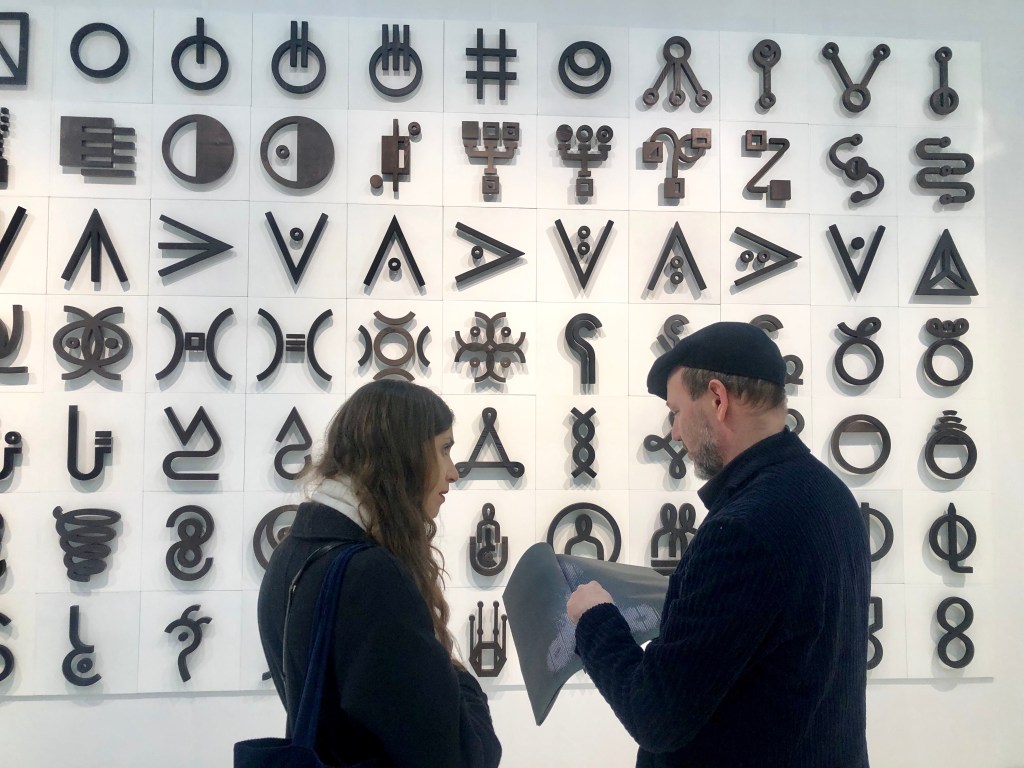
David Reimondo, a brilliant artist from Milan, had his New York debut with his massive and thought-provoking “Etimografia.” I just happened to see this art work about five years ago when it was still a work in progress. “Etimografia” is an intellectual tour de force, and by far the most cerebral art work at the fair. Artists often like to say that their goal is to create their own visual language. Well, Reimondo has done that, literally. The art work is his years-long research into language, and it features dozens of ideograms, pictograms and glyphs. Each has its own sound and meaning. They’re not letters, but rather concepts; something more like hieroglyphs.
David Reimondo’s “Etimografia” . Photo credit: NY Artscape
At Dittrich & Schlechtriem Gallery (Berlin) there’s a joyful art work by Alfredo Aceto (“Laughing Window II”), juxtaposed with a surrealistic work by Robert Lazzarini (“Police barricade”), which is inspired by the ubiquitous New York Police Department barricades. The art work seems to be a challenge to authority, perhaps a protest again police brutality, which is sadly quite common in the USA.
Alfredo Aceto and Robert Lazzarini. Photo credit: NY Artscape
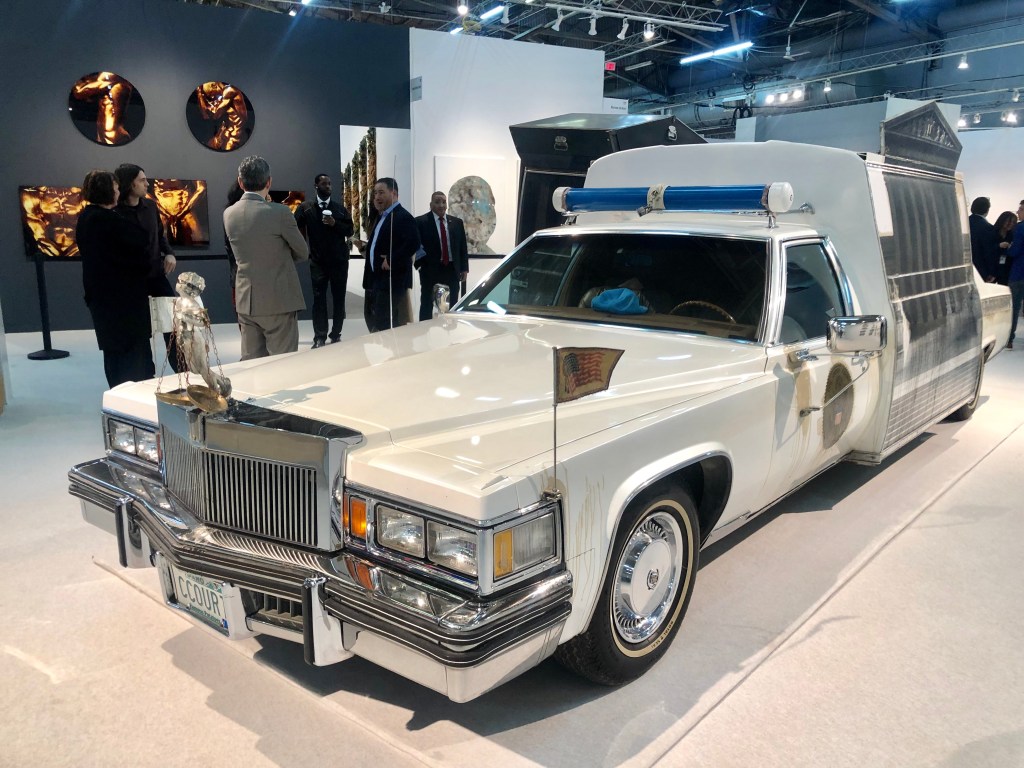
The Armory Show’s central piece is Edward and Nancy Kienholz’s spectacular installation, “The Caddy Court”, made about 35 years ago. Featuring an early 1980s vintage American car, it occupies the largest amount of space at the show, and is a hit with social media influencers.
Keinholzs’ “The Caddy Court” (1986-87). Photo credit: NY Artscape
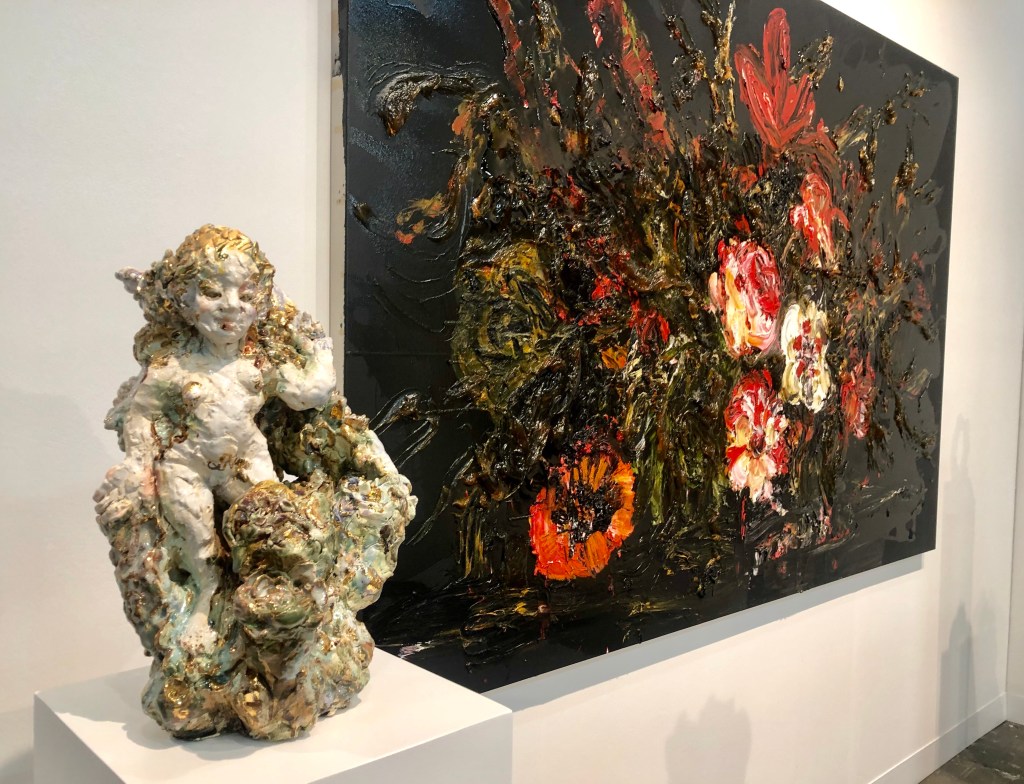
Forsblom Gallery from Helsinki provides a sophisticated touch with its subtle dialogue of two artists: painter Heikki Marila (“Flowers”) and sculptor Emma Helle (“The Faun and the Frog”). Both works are a contemporary twist inspired by the Rocco style of the late 18th century.
Heikki Marila and Emma Helle. Photo credit: NY Artscape
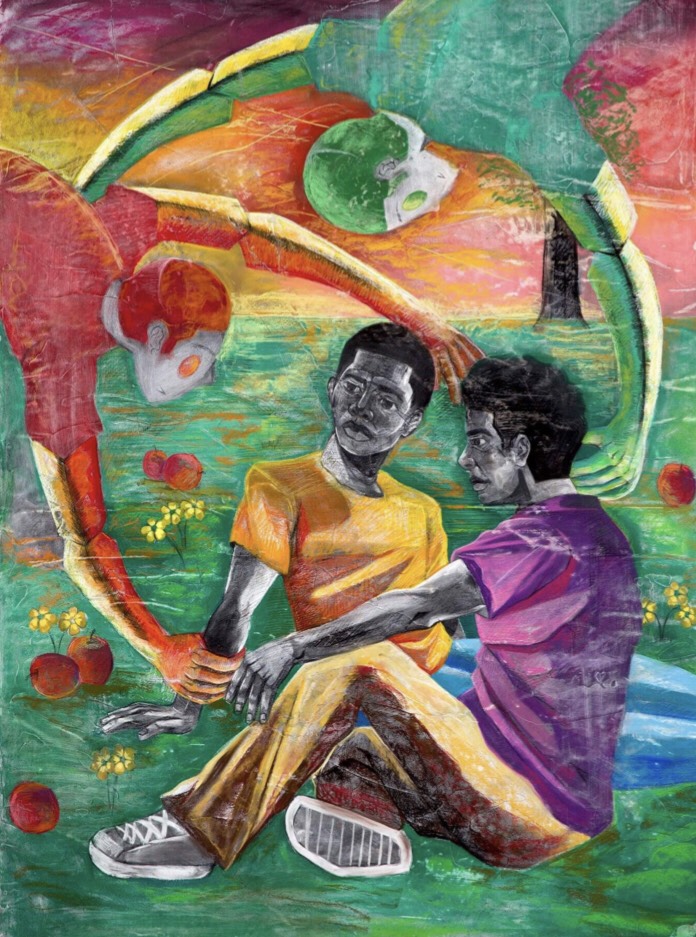
Finally, Anna Zorina Gallery has a wonderful solo exhibition by Dominic Chambers, an African-American artist from St. Louis, doing his MFA at Yale University. Utilizing a rich and varied color field Chambers’ paintings explore moments of contemplation and meditation through reading and leisure. The young artist certainly has a great future ahead of him.
Dominic Chambers’ “Apple Spirits” (2019-2020). Photo credit: Anna Zorina Gallery
The Armory Show runs until March 8, and is located at Pier 90 and Pier 94 on the Hudson River, (Manhattan’s West Side, by 50th Street). For more information: https://www.thearmoryshow.com
I made a repeat visit to East Harlem last week, this time to see a fantastic exhibition by New York-based artist, Roland Gebhardt, who was making his debut at David Richard Gallery.
“New Work – Floor and Wall Sculptures” is his solo presentation of new studio works included 14 wall-mounted sculptures produced from 2017 through 2019 in a variety of materials, including zinc, aluminum and paper.
With their angled cuts and undulations from the various materials, these art works have the appearance of floating on the wall, a nod to the notion of illusory space.
“Gebhardt creates an internal tension within his wall sculptures that successfully suggests the possibility of a three-dimensional structure in a two-dimensional plane,” said the gallery in a press statement.
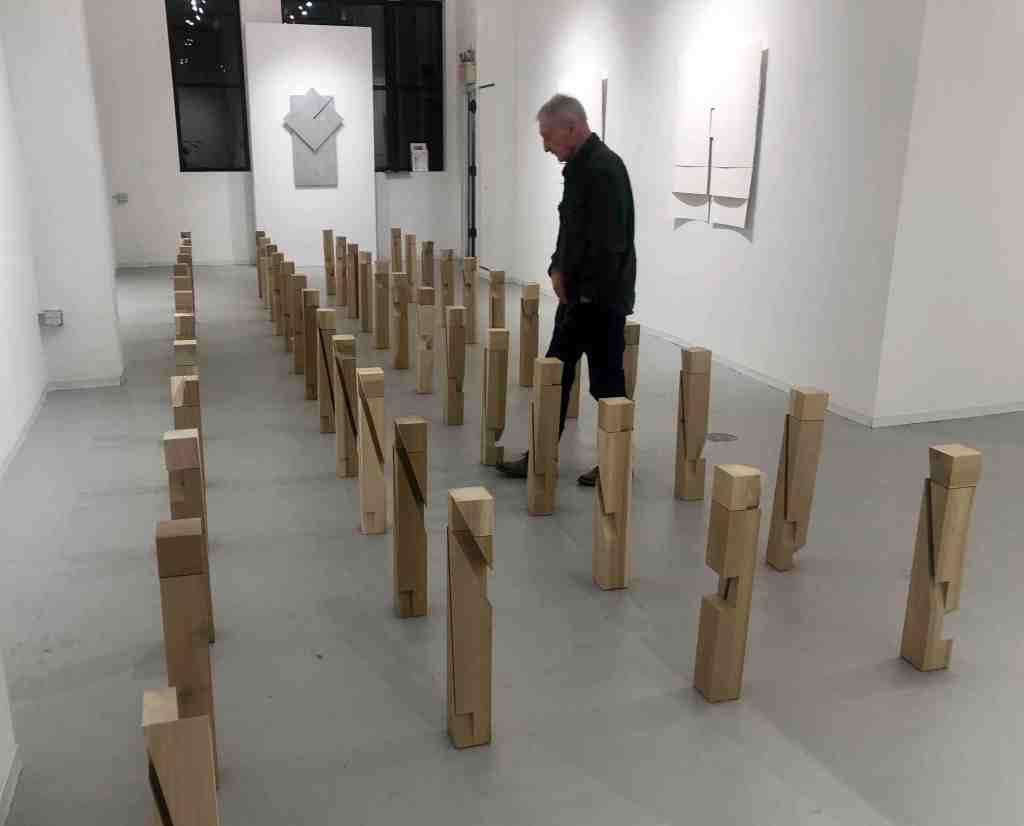
The main art work, however, is the debut of a new installation piece comprised of 49 vertical wooden columns with slices removed in Gebhardt’s usual serial fashion that explore “various permutations of cuts and orientations on different faces, each placed on the floor in an array.”
Roland Gebhardt walks amid his installation. (credit: John Varoli)
The columns are arranged in linear arrays as floor pieces with wide spaces between each that invite the viewer to walk in and around the installation.
“Gebhardt is known for his minimalist sculptures that he has been producing since the early 1970s. This particular presentation highlights current and new works and focuses on his ongoing exploration of space, or better yet, voids,” the gallery said in a press statement.
Roland Gebhardt was born in Paramaribo, Suriname 1939. He studied at the Kunstgewerbeschule in Zurich and earned a Master of Fine Arts at the Art Academy of Hamburg. He is a sculptor working in a variety of media and exhibits internationally.
The exhibition is on view from January 26 – February 21, 2020 at David Richard Gallery located at 211 East 121 Street, New York.
Meanwhile, down in TriBeCa… I popped into The Journal Gallery (45 White Street) to see a small exhibition by Marco Pariani, an Italian artist now working in Brooklyn, and who says that one of his goals is “to go to live on the moon”. Indeed, his art is out-of-this-world and an enjoyable visual feast.
Born in 1986 in Busto Arsizio, Italy, Pariani received his BFA from the Academy of Fine Art of Brera in Milan. He works with several media — oil, acrylic and spray paint. His paintings certainly have an edgy street art feel.
Humanize Animals, 2020 Oil, acrylic and spray paint on canvas
“I really love spray paint I think that is really hard to use them and was a kind of challenge for me to learn from single caps and different brands. On canvas, spray paints are really important for me because I love the contrast with the acrylic colors,” said Pariani. “My style is a result of many years of work and I love to use contrasts between materials, like spray paint and acrylic, and colors, like green and pink, pink and grey and other colors that I love in particular inside my palette.”
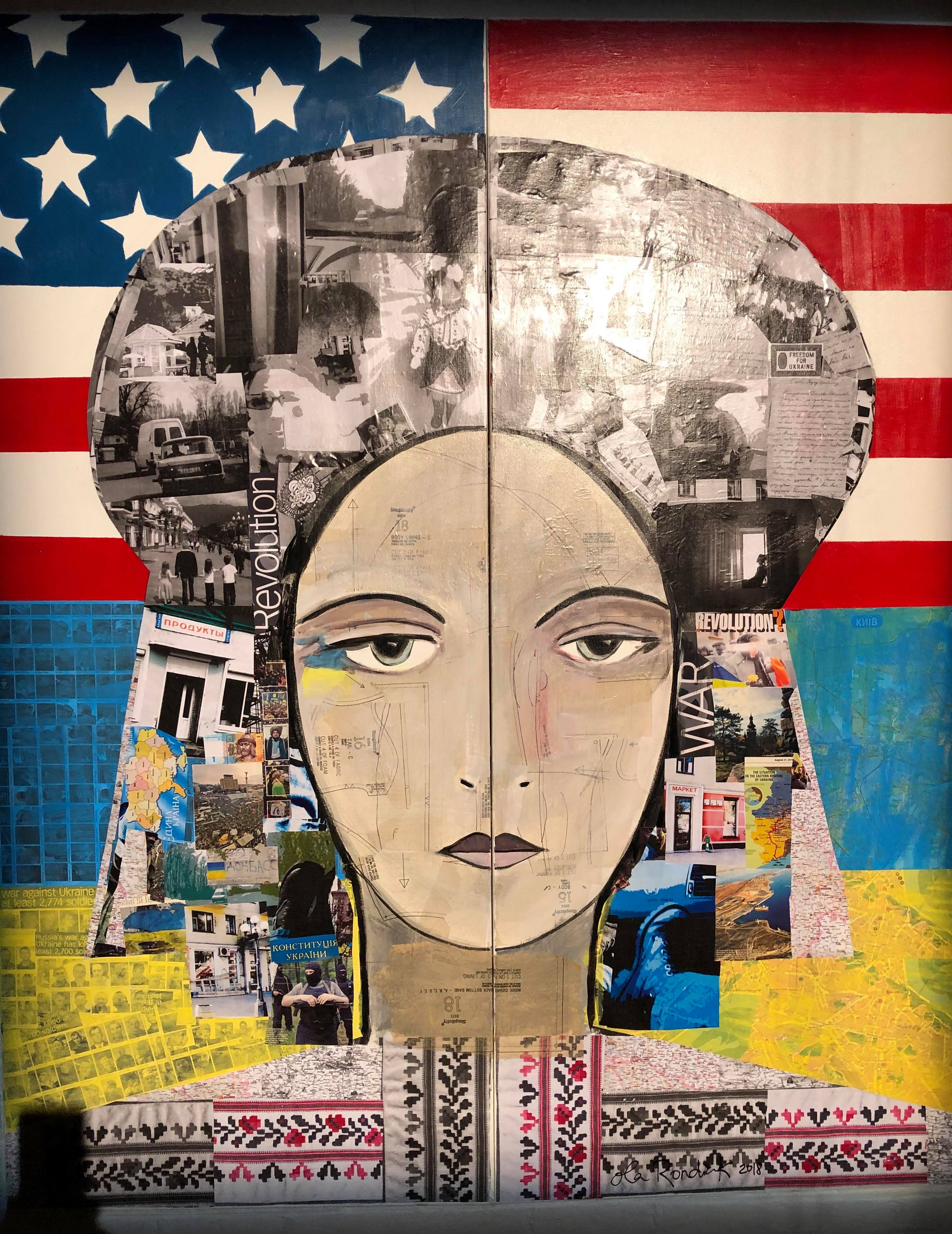
“Metempsychosis,” a solo exhibition of works by artist Ola Rondiak now on display at WhiteBox-Harlem Art Center until Jan. 26, is one of the holiday season’s best unexpected ‘sleeper’ sensations in New York City.
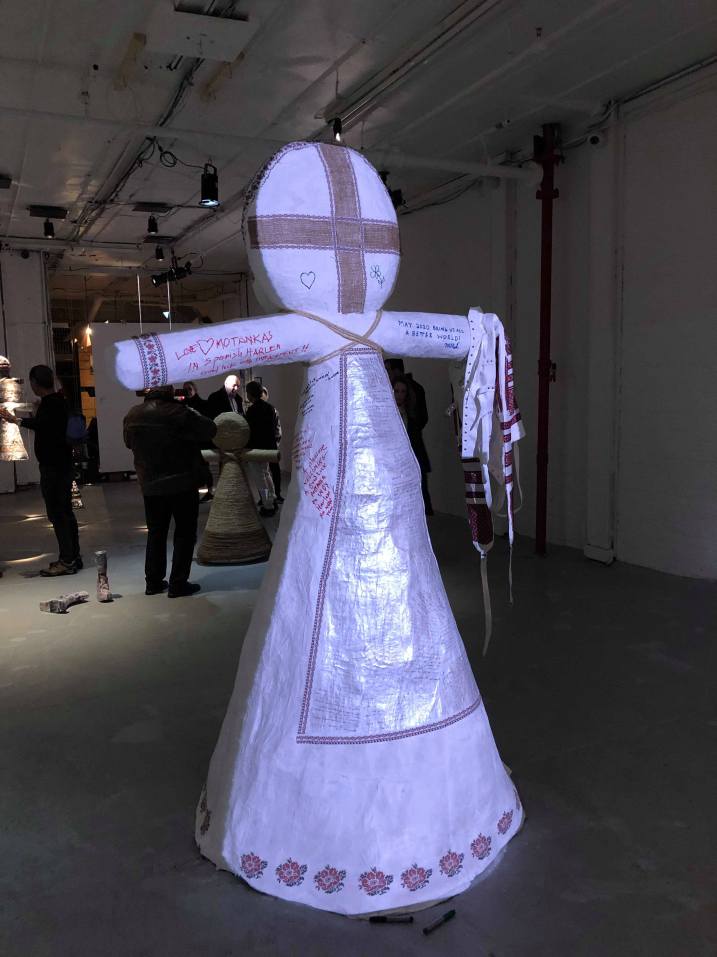
Harlem Motanka, (2019)
This exhibition comes as a pleasant surprise in every way; well executed in every aspect — the quality of the art works, the atmospheric lighting, the edgy ambience, and the artist’s warmth and hospitality.
The thrill and delight begins as soon as you exit the subway in East Harlem. Stepping outside, you immediately feel you’re back in that edgy 1980s Manhattan, an era in the city’s history that was marked by both incredible freedom and creativity, but also lots of dodgy characters on the street. No reason to worry, however; unlike the 1980s, today the NYPD heavily patrols this neighborhood.
Upon setting foot into White Box, the exhibition immediately becomes a silent feast for the visual senses — a large ‘motanka’ stands watch over the entire hall; the lighting is sensual and seductive, enticing you further into the exhibition space.
Borders Motanka, (2019)
Born in Ohio and steeped in Ukrainian culture over the course of her upbringing in the USA, Ms Rondiak is a Ukrainian-American who moved back to Ukraine in the mid 1990s and stayed. Today, she finds herself as an artist caught in the tumultuous and often surrealistic times that define Ukraine and US relations.
Walking around the exhibition, you start wondering: Just what does ‘metempsychosis’ mean? Turns out that this is a philosophical term from Ancient Greece that refers to transmigration of the soul, especially its reincarnation after death. In recent decades, the term metempsychosis has been recontextualised by modern philosophers and artists.
Identity, (2018)
Rondiak’s extraordinary artworks are inseparable from her own experience, which is expressed in her oeuvre that dazzles the public with her ‘art as historical conscience’.
Her art is folk-inspired and seems to challenge the widely-held belief that in order to be ‘contemporary’ one must entirely turn their back on the past; and that ‘proper’ and ‘sellable’ contemporary art must conform to the widely accepted ‘globalized-anodized’ body of works that we see in many major art fairs.
This brings us to question No. 2? What’s a ‘motanka’? These traditional Ukrainian dolls are meant to protect a child from evil spirits and to restore health. Ms Rondiak began to make her own when she discovered her grandmother’s miraculously preserved motankas, which she made while unjustly jailed in a Soviet gulag camp. Traditionally the motankas were made out of rags but Ms Rondiak has made them out of plaster of Paris, which of course is used to treat broken bones (casts); this symbolizes the element of healing after the war broke out in eastern Ukraine.
Camouflage Motanka (2019)
In these motankas Ms Rondiak sees the image of her grandmother’s feat of survival, and her determination to make something valuable and with healing properties out of practically nothing, despite being in a place of great terror and repression.
Ms Rondiak seeks to honor and celebrate her grandmother’s accomplishment in trying to extend health and safety for her imprisoned comrades during the Stalinist era. And perhaps these motankas are bringing health and safety to her family today, as well as the exhibition audience, across space and time.
Shevchenko Motanka (2019)
The exhibition in Harlem will run simultaneously with one in Ukraine; similar artworks of motankas will open on Jan 15 at the Kyiv History Museum, presented by the Revolution of Dignity Museum/ Maidan Museum.
Also, a live stream discussion panel will be held at noon on Jan. 11 in the office of the Ukrainian Congress Committee of America (New York City) and at the Maidan Museum (Kyiv) at 7 p.m.






















 New York Artscape